 Bullish Portfolio

Introduction to Crypto Compounding for Financial Independence
Cryptocurrency offers unique opportunities for compounding returns that can accelerate progress toward financial independence. Unlike traditional assets that trade during limited market hours, crypto markets operate continuously with protocols specifically engineered to reward ongoing participation through dynamic yields. This comprehensive guide examines staking mechanisms, yield farming techniques, DeFi protocol integrations, and volatility-adjusted calculations tailored for advanced investors exploring alternatives to conventional stock market strategies. Compounding works by systematically reinvesting generated earnings so that future returns build upon an ever-growing principal base, creating exponential growth curves when yields hold steady and downside risks receive proactive management.
Investors pursuing financial independence through crypto must balance the allure of elevated nominal returns against the inherent operational complexities and market swings unique to digital assets. The following sections provide in-depth coverage of each compounding avenue along with actionable implementation frameworks.
Understanding Staking Strategies in Depth
Staking represents one of the most accessible entry points for crypto compounding. Participants lock tokens to secure proof-of-stake blockchains and receive periodic reward distributions proportional to their committed stake. Networks such as Ethereum rely on this model for transaction validation, allowing holders to earn yields simply by maintaining validator status or delegating to reliable operators. Selection criteria for validators include historical uptime percentages, commission structures, and community reputation to preserve maximum net compounding efficiency.
Practical implementation begins with evaluating wallet security options such as hardware devices that store private keys offline. Next, investors research current network parameters including minimum staking thresholds and reward issuance schedules. Diversification across several proof-of-stake chains mitigates concentration risk while preserving the compounding trajectory. Monitoring tools track reward accrual in real time, enabling timely adjustments when validator performance declines or network upgrades alter economics.
Yield Farming and Liquidity Provision Techniques
Yield farming extends basic staking by supplying liquidity to decentralized exchanges where users earn trading fees plus additional incentive tokens. Liquidity pools facilitate automated market making, and participants receive LP tokens representing their share that can be staked further for boosted returns. Sustainable pool selection requires analysis of token emission schedules to avoid rapid incentive decay that could reverse compounding gains through impermanent loss.
Advanced farmers utilize calculators that factor gas fees, token price correlations, and reward reinvestment frequency. Automated platforms periodically harvest and redeposit earnings, reducing manual intervention and preserving compounding continuity during volatile periods. Risk mitigation includes setting position size limits and maintaining reserves for potential impermanent loss offsets.
DeFi Protocols and Automated Compounding Systems
Decentralized finance protocols introduce sophisticated automation layers that handle compounding without constant user oversight. Smart contract vaults accept deposits and continuously cycle rewards across lending markets, liquidity pools, and leveraged strategies. This architecture minimizes transaction costs while capturing fleeting yield opportunities that manual approaches often miss.
Popular protocol categories encompass over-collateralized lending platforms, automated market makers, and derivative protocols that allow synthetic exposure. Users must understand liquidation thresholds and collateral ratios to prevent forced position closures during sharp price movements. Regular review of protocol audits and governance proposals helps maintain alignment with long-term compounding objectives.
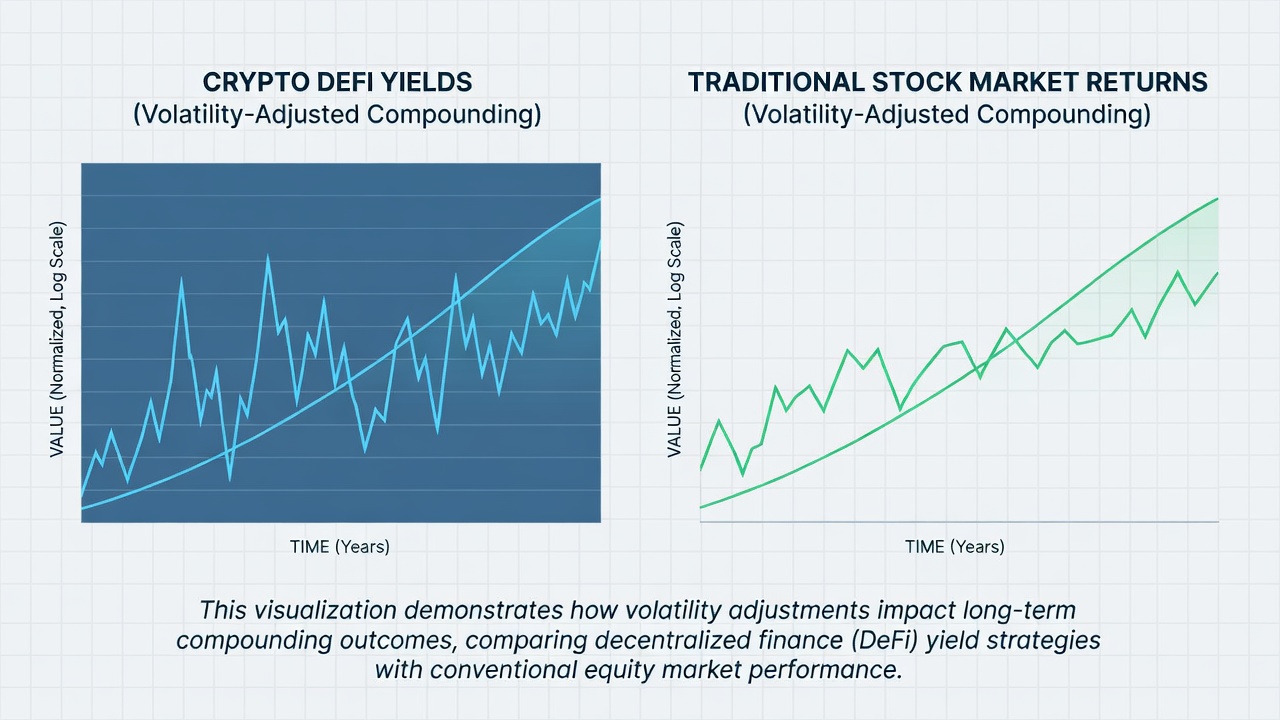
Volatility-Adjusted Compounding Calculations
Standard compounding formulas assume stable returns, yet crypto volatility demands adjusted models. Investors incorporate metrics such as rolling standard deviation, maximum drawdown duration, and risk-adjusted return ratios to discount optimistic projections. A practical approach multiplies expected yield by a volatility factor derived from historical price data, producing conservative forward estimates suitable for financial independence planning.
Side-by-side comparisons with equity compounding reveal that stock market strategies using broad index vehicles deliver steadier trajectories with lower operational overhead. Crypto paths can generate superior terminal wealth under favorable conditions but require active monitoring and contingency buffers. Spreadsheet models that simulate thousands of volatility scenarios help investors visualize probability distributions around target independence dates.
Practical Portfolio Setup Steps with Detailed Guidance
- Conduct a thorough risk assessment covering both market and operational exposures, allocating only capital resilient to substantial interim declines.
- Perform due diligence on networks and protocols by reviewing whitepapers, on-chain metrics, and independent security audits before committing funds.
- Establish secure infrastructure using hardware wallets paired with multi-signature configurations and cold storage for long-term holdings.
- Configure automated reinvestment workflows through trusted vault contracts or portfolio management dashboards to maintain consistent compounding cadence.
- Integrate tax tracking software that categorizes rewards as income events and logs cost basis for future capital gains calculations.
- Establish periodic review cadences, such as quarterly rebalancing, to adapt allocations as market conditions and personal circumstances evolve.
Real-World Investor Examples and Side-by-Side Comparisons
Documented cases among sophisticated participants illustrate how disciplined application of crypto compounding has produced accelerated wealth trajectories compared with equity benchmarks during certain market regimes. One illustrative profile involves an investor who allocated across multiple staking networks and automated DeFi vaults, achieving cumulative growth that outpaced broad stock indexes over multi-year horizons despite intermittent drawdowns. Another example highlights a liquidity provider who rotated between pools based on yield sustainability signals, preserving capital through incentive shifts that eroded less-prepared positions.
Comparative analysis against traditional stock-based compounding underscores trade-offs in predictability versus upside potential. Equity strategies benefit from regulatory clarity and lower technical barriers, while crypto approaches demand continuous education and infrastructure maintenance. Decision matrices weighing time commitment, technical proficiency, and regulatory outlook guide allocation percentages between the two domains.
Security Best Practices and Common Pitfalls to Avoid
Security remains paramount when managing compounding positions. Best practices include never exposing seed phrases online, enabling transaction confirmations on hardware devices, and limiting smart contract approvals to essential interactions only. Phishing attempts and rug-pull schemes targeting DeFi users necessitate ongoing vigilance and verification of contract addresses through official channels.
Common mistakes include over-leveraging positions without adequate buffers, neglecting gas fee optimization during high network congestion, and failing to diversify across uncorrelated protocols. Avoiding these pitfalls preserves compounding integrity over extended timeframes.
Security, Taxes, and Regulatory Considerations
FAQ
How can investors secure crypto compounding positions? Hardware wallets combined with multi-factor authentication and regular security audits of connected smart contracts provide layered protection against unauthorized access and exploits.
What tax obligations apply to compounded crypto earnings? Reward distributions are generally classified as taxable income at the time of receipt under prevailing rules in many jurisdictions. Accurate record-keeping and professional consultation ensure compliance with reporting standards.
Which regulatory bodies oversee DeFi activities? Oversight frameworks differ by region; authoritative guidance is available from the U.S. Securities and Exchange Commission, the Internal Revenue Service, and foundational documentation at Ethereum Foundation resources. Investors should monitor updates from these entities for evolving compliance requirements.
Conclusion
Crypto compounding strategies equip advanced investors with potent mechanisms for expediting financial independence when executed with rigorous risk controls and continuous learning. Integrating staking, yield farming, and automated DeFi solutions while applying volatility-adjusted projections creates resilient portfolios that complement rather than replace traditional market participation. Success ultimately hinges on disciplined execution, proactive security measures, and adaptability to the rapidly evolving digital asset landscape.

No comments yet. Be the first!