 Bullish Portfolio

Introduction to AI Portfolio Rebalancing
In 2026, investors pursuing long-term financial independence are increasingly adopting AI-powered portfolio rebalancing tools to supercharge compounding returns. These advanced systems process vast amounts of market data in real time, automatically adjusting asset allocations to maintain optimal risk levels while minimizing unnecessary trading costs. Unlike manual rebalancing, which relies on periodic human intervention and can suffer from behavioral biases, AI-driven approaches deliver consistent execution that supports sustained wealth accumulation over decades.
The core benefit lies in how AI identifies subtle drifts in portfolio weights caused by market movements and executes precise adjustments. This precision preserves the power of compounding by keeping investments aligned with target allocations that favor growth assets over time. For those focused on FI goals, such tools transform rebalancing from a reactive chore into a strategic advantage that accelerates progress toward early retirement or financial freedom.
Why AI Rebalancing Enhances Compounding Returns
Compounding wealth depends on uninterrupted growth and disciplined allocation. Traditional manual methods often result in delayed responses to market volatility, leading to prolonged exposure to underperforming assets or excessive risk. AI rebalancing counters this by continuously monitoring correlations between holdings, volatility patterns, and macroeconomic indicators to determine ideal rebalancing points.
By reducing emotional decision-making and optimizing trade timing, these tools lower transaction costs and tax drag while maximizing exposure to high-performing segments. Over a 20- or 30-year horizon, even modest improvements in annual returns can translate into substantially larger portfolios. Authoritative guidance from financial regulators underscores the value of consistent allocation strategies, as noted on SEC investor resources.
How AI Rebalancing Works Technically
Modern AI platforms employ machine learning models trained on historical market data, economic indicators, and user-specific risk profiles. These models predict optimal rebalancing thresholds and simulate thousands of scenarios to recommend actions. Key inputs include asset correlations, dividend reinvestment rates, and projected inflation impacts, allowing the system to balance growth with downside protection.
Advanced implementations also incorporate natural language processing to interpret news sentiment and adjust allocations preemptively. This technical depth sets AI tools apart from rule-based robo-advisors, delivering more nuanced responses to 2026 market conditions.
Integration with Popular Brokerages
Seamless connectivity remains essential for widespread adoption. Top AI rebalancing solutions integrate directly with Fidelity, Vanguard, Charles Schwab, and Interactive Brokers through secure APIs. Users grant limited permissions for data analysis while retaining full control over account assets within insured brokerage environments.
Setup involves OAuth authentication that syncs positions daily without requiring asset transfers. This preserves access to brokerage-specific features such as fractional shares, automatic dividend reinvestment, and tax-lot tracking. Integration supports both taxable brokerage accounts and tax-advantaged vehicles including IRAs, Roth IRAs, and 401(k) rollovers, making the technology accessible across diverse investor profiles.
Comparing Leading AI Rebalancing Platforms
Selecting the right platform requires evaluating algorithm transparency, tax optimization capabilities, and user experience. Platform A stands out for sophisticated tax-loss harvesting across more than 50 asset classes and strong backtesting tools. Platform B emphasizes intuitive dashboards and scenario modeling tailored to FI timelines. Platform C prioritizes low-cost ETF universes with minimal fees and excellent mobile accessibility.
Each option offers distinct strengths depending on portfolio size and complexity. Investors should test demo accounts to assess how well each aligns with personal goals before committing.
Step-by-Step Setup Guide
Follow these detailed steps to implement AI rebalancing effectively:
- Choose and sign up for a compatible platform, then link your brokerage account using secure API credentials.
- Input your current holdings, target allocation percentages, risk tolerance score, and any time-bound FI milestones.
- Configure custom rules such as minimum trade size thresholds, tax sensitivity settings, and excluded assets.
- Run an initial analysis to review proposed adjustments and simulate historical performance under the new rules.
- Activate automated monitoring with alerts for significant market events or drift beyond defined bands.
- Schedule periodic reviews, typically quarterly, to refine parameters based on life changes or updated projections.
Key Metrics to Track for Success
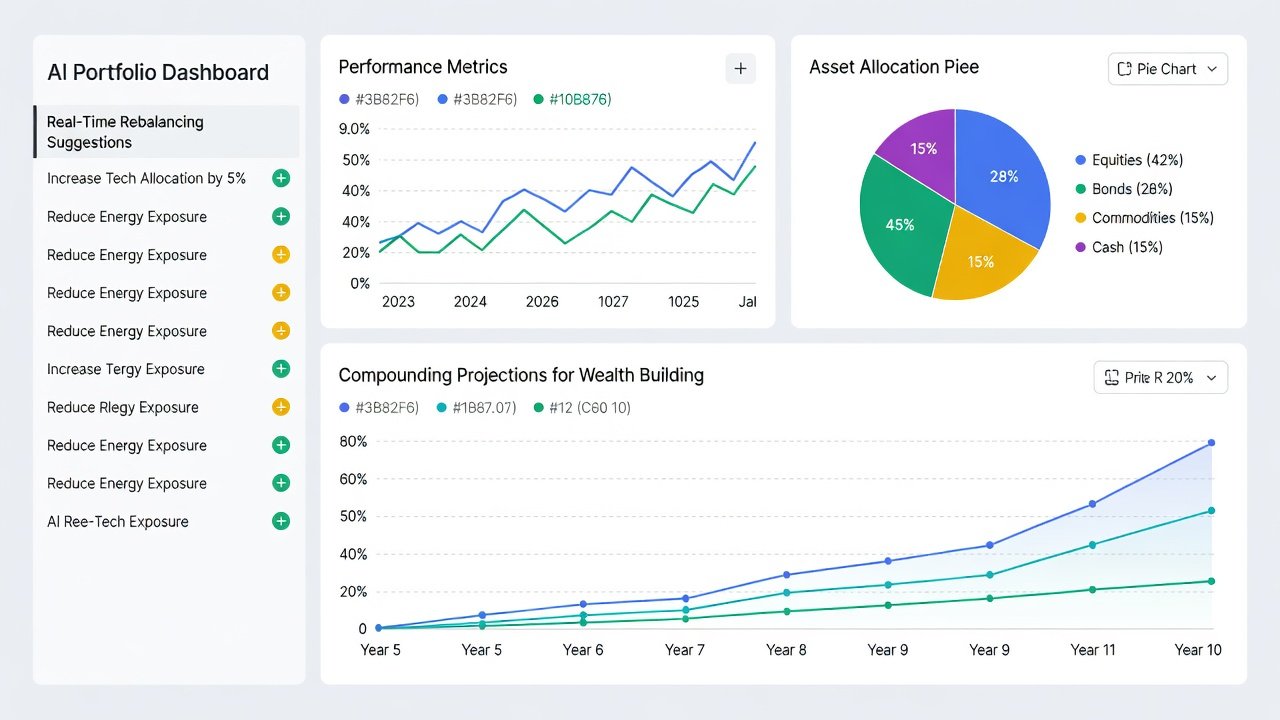
Effective oversight relies on monitoring several quantitative indicators. Portfolio drift percentage measures deviation from targets. Sharpe ratio improvements highlight risk-adjusted return gains. Tax efficiency rate tracks the proportion of gains realized in a tax-advantaged manner. Finally, projected compounding growth versus a static benchmark provides a clear visual of long-term acceleration.
Regular review of these metrics helps investors quantify the AI advantage and make informed adjustments.
Real-World Examples of Outperformance
Consider a hypothetical investor with a 60/40 stock-bond portfolio who switched to AI rebalancing in early 2025. During subsequent volatility, the system maintained tighter adherence to targets, avoiding the common manual error of selling low during dips. The result was approximately 1.2 percentage points higher annualized returns over 18 months compared to a manually managed counterpart, demonstrating tangible compounding benefits.
Similar patterns appear in case studies shared by users of leading platforms, where consistent rebalancing during sector rotations preserved gains and reduced drawdowns.
Practical Tactics for 2026 Wealth Building
Combine AI rebalancing with complementary strategies such as dollar-cost averaging into undervalued sectors and strategic use of tax-advantaged accounts. Set rebalancing bands wider during low-volatility periods to reduce trading frequency. Review AI recommendations against personal conviction levels to maintain a hybrid human-AI approach when appropriate.
Common Mistakes to Avoid
- Overriding AI suggestions too frequently based on short-term market noise.
- Ignoring tax implications when rebalancing in taxable accounts.
- Failing to update risk parameters after major life events such as inheritance or career changes.
- Neglecting to verify data accuracy from brokerage feeds on a regular basis.
Tax Considerations and Data Privacy FAQs
How does AI handle tax implications? Most platforms prioritize tax-efficient trades and integrate with IRS guidelines for wash-sale avoidance. Consult IRS official resources for detailed rules.
What privacy protections exist? Reputable providers employ end-to-end encryption and never retain brokerage login details. Always review each platform's data policy before linking accounts.
Are costs predictable? Pricing structures typically scale with assets under management rather than fixed fees, allowing investors to evaluate value qualitatively based on portfolio size and features used.
Conclusion
AI portfolio rebalancing represents a practical evolution in wealth-building technology for 2026. By delivering precise, data-driven adjustments across integrated brokerages and focusing on key performance metrics, these tools help investors compound returns more effectively on the path to financial independence. Begin with a platform aligned to your brokerage and risk profile, then maintain consistent oversight to realize sustained benefits over the long term.
No comments yet. Be the first!