 Bullish Portfolio

Introduction to the 3-Bucket Tax Strategy
Retirement planners navigating 2026 must address shifting tax rules and market conditions with a structured approach to tax diversification. The three-bucket framework divides retirement assets into distinct categories: Roth IRA accounts for tax-free growth and qualified withdrawals, traditional 401(k) plans for tax-deferred contributions and growth, and taxable brokerage accounts for immediate access without penalties. This implementation guide emphasizes actionable steps, precise allocation guidance tied to projected brackets, and ongoing management techniques to minimize lifetime tax burdens. Mid-to-advanced investors benefit most from this method because it creates flexibility across different retirement phases, allowing withdrawals from the most tax-efficient source at any given time. Effective execution requires understanding not only contribution rules but also how rebalancing interacts with annual tax filings and required minimum distributions later in life. By following the detailed processes outlined here, individuals can build a resilient portfolio that adapts to income needs while preserving wealth across market cycles and legislative changes.
The Three-Bucket Framework in Detail
Bucket one centers on Roth IRAs and Roth 401(k) conversions, delivering completely tax-free qualified distributions after age 59½ and a five-year holding period. This bucket excels during high-tax years in retirement when minimizing taxable income becomes critical. Bucket two relies on traditional 401(k) and IRA contributions that reduce current taxable income but create future tax obligations upon withdrawal. Bucket three encompasses taxable accounts where capital gains rates apply, offering no upfront deduction yet full liquidity and favorable long-term rates. Together these buckets enable strategic sequencing of withdrawals to stay within lower tax brackets each year. Each bucket also carries unique rules around contribution limits, income eligibility, and early access penalties that planners must weigh when building positions.
Why Tax Diversification Matters in 2026
Tax diversification protects against uncertainty in future tax policy, inflation adjustments to brackets, and personal changes in income or filing status. Without it, retirees may face concentrated withdrawals from traditional accounts that push them into higher marginal rates or increase taxation of Social Security benefits. The three-bucket approach spreads risk and provides options for charitable giving, estate planning, and healthcare cost management. Planners who diversify early gain compounding advantages that compound over decades, often resulting in substantially lower effective tax rates on total retirement income.
2026 Tax Brackets and Recommended Allocations
Allocation targets should reflect expected retirement tax rates relative to current brackets. A balanced starting point places 25-35 percent of total retirement assets in Roth accounts, 40-50 percent in traditional 401(k) vehicles, and 20-30 percent in taxable accounts. Investors anticipating higher future rates may increase Roth exposure to 40 percent, while those expecting lower brackets can maintain heavier traditional allocations. These percentages are not static and should be recalibrated annually based on changes in income, filing status, and legislative updates. Monitoring projected brackets helps avoid overfunding any single bucket that could limit flexibility.
Step-by-Step Rebalancing Instructions
Rebalancing maintains target percentages without creating excessive tax events. Begin by totaling all account values at year-end and calculating current bucket weights. Next, direct new contributions and employer matches toward underweight buckets. Perform Roth conversions selectively during low-income years, modeling the impact on Medicare premiums and the five-year rule. Harvest tax losses in taxable accounts to offset realized gains elsewhere. Finally, document every adjustment and review the entire plan after major life events such as inheritance or career changes. Consistent execution prevents drift that could erode tax advantages over decades. Additional considerations include coordinating rebalancing with employer stock sales and monitoring net investment income tax thresholds in taxable accounts.
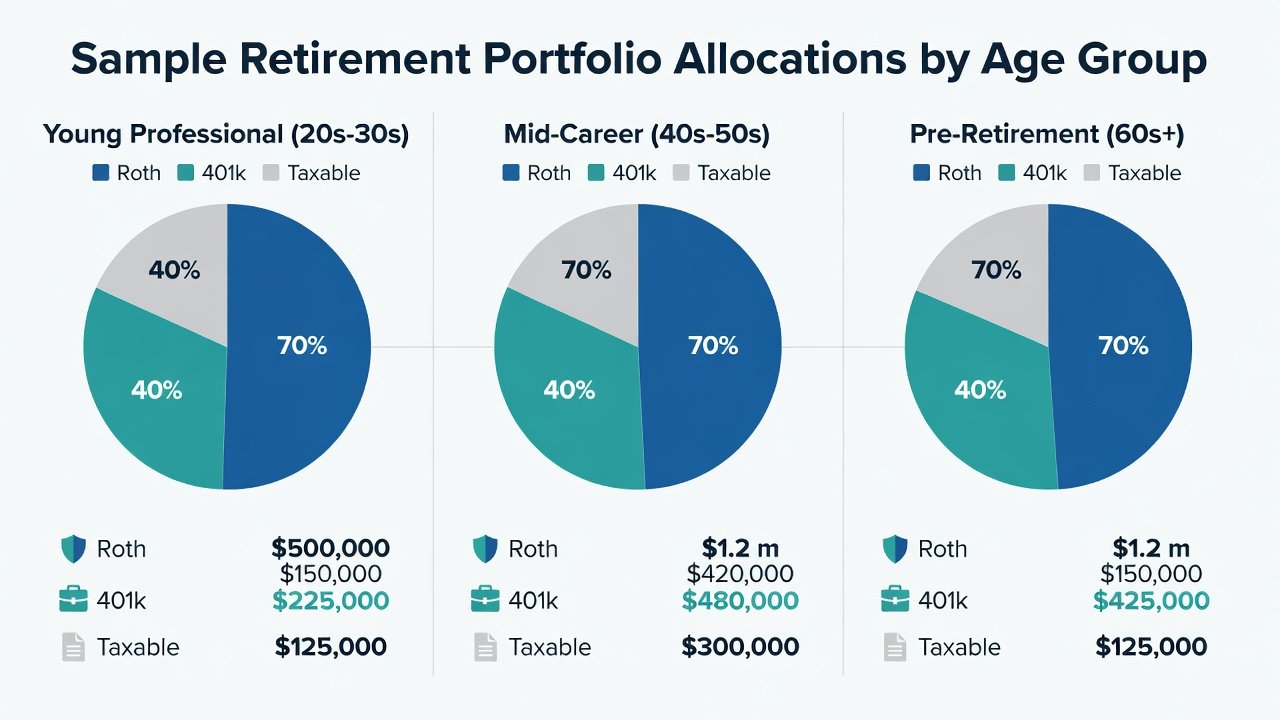
Sample Portfolio Examples by Age Group
Age 35-45: Growth-Focused Allocation
Younger investors allocate approximately 30 percent to Roth IRA, 45 percent to traditional 401(k), and 25 percent to taxable accounts. Equity concentration within the Roth bucket maximizes the benefit of tax-free compounding over 30-plus years. Regular contribution increases and occasional backdoor Roth strategies further strengthen this bucket during peak earning years. For a sample $500,000 portfolio at age 40, this translates to $150,000 Roth, $225,000 traditional, and $125,000 taxable, with new savings directed first to the Roth component.
Age 50-60: Pre-Retirement Balance
Individuals in this range shift to 35 percent Roth, 40 percent traditional 401(k), and 25 percent taxable. Catch-up contributions become available at age 50, allowing accelerated funding of Roth accounts. Partial conversions from traditional accounts during sabbatical years or early retirement transitions help fine-tune future tax exposure. An example $1.2 million portfolio at age 55 might hold $420,000 Roth, $480,000 traditional, and $300,000 taxable, with annual adjustments for market movements.
Age 65+: Withdrawal Phase
Retirees often target 40 percent Roth, 35 percent traditional, and 25 percent taxable. This mix supports management of required minimum distributions by drawing from Roth accounts first in high-income years and using taxable accounts for flexibility around capital gains harvesting. A $2 million portfolio at age 68 could allocate $800,000 Roth, $700,000 traditional, and $500,000 taxable to optimize distribution sequencing.
20-Year Tax Savings Comparison
| Strategy | Projected Tax Savings | Key Assumption |
|---|---|---|
| Traditional Only | $0 baseline | No diversification |
| 3-Bucket Balanced | 18-25% reduction | Consistent rebalancing |
| Roth-Heavy | 22-30% reduction | Early conversions executed |
Additional Considerations for Market Volatility and RMDs
Market downturns require careful rebalancing to avoid selling assets at depressed values. Maintain a cash buffer in taxable accounts equivalent to one to two years of planned withdrawals. When handling required minimum distributions after age 73, coordinate distributions across buckets to minimize the tax impact on Social Security taxation and Medicare surcharges. Investors can also explore qualified charitable distributions from traditional accounts to satisfy RMDs without increasing taxable income. For more details, see guidance from the IRS on distribution rules.
Common Pitfalls and Tracking Tools
- Improper Roth conversions that push income into higher brackets or trigger IRMAA surcharges.
- Neglecting the five-year rule on converted amounts, leading to unexpected penalties.
- Failing to update allocations after receiving inheritances or large bonuses.
- Overlooking state tax implications when moving between jurisdictions.
- Ignoring the interaction between bucket withdrawals and taxation of Social Security benefits.
Tracking tools include comprehensive platforms from major brokerages that aggregate all account types and project future tax scenarios. Spreadsheet templates customized for bucket percentages provide an additional layer of control for hands-on planners. Regular reviews with a fiduciary advisor help catch errors before they compound. Additional resources on benefit coordination are available through the Social Security Administration.
Conclusion
Successful implementation of the 2026 three-bucket tax strategy demands ongoing attention to allocation targets, disciplined rebalancing, and awareness of evolving tax rules. The examples, steps, and comparisons provided equip retirement planners with concrete action plans that deliver measurable tax efficiency over 20 years and beyond. Professional guidance ensures the approach aligns with individual circumstances and regulatory changes, ultimately supporting a more secure and tax-efficient retirement.

No comments yet. Be the first!