 Bullish Portfolio

Introduction to Retirement Planning for Military Families
Military service brings unique financial challenges and opportunities, especially when planning for retirement. In 2026, service members and their families can leverage Roth IRA and traditional or Roth 401(k) accounts alongside the Thrift Savings Plan (TSP) to build tax-advantaged wealth. This comprehensive guide provides in-depth strategies tailored to PCS moves, deployments, and post-service life, helping families navigate irregular pay cycles and maximize every advantage available under current tax rules.
Understanding contribution limits, tax treatments, and rollover options helps maximize benefits like combat zone tax exclusions. Families often face irregular income due to deployments, making flexible tools such as spousal IRAs essential for maintaining consistent retirement progress. Whether you are an active-duty member preparing for your next move or a veteran transitioning to civilian employment, the combination of Roth accounts and employer-sponsored plans offers powerful pathways to financial security.
Key Benefits of Roth IRA and 401(k) for Service Members
Roth accounts offer tax-free growth and qualified withdrawals, ideal for those expecting higher tax brackets after service. Traditional contributions provide upfront tax deductions, beneficial during high-earning years. The TSP serves as a core 401(k)-style vehicle with low-cost funds that rival or beat many private-sector plans in expense ratios. Combat zone tax exclusions allow tax-free contributions to traditional TSP or 401(k) accounts, reducing taxable income significantly while still permitting future Roth conversions at potentially lower rates.
Roth conversions during low-income periods, such as after retirement or during extended leave, can lock in tax-free growth for decades. Military families benefit further from the ability to contribute to IRAs even when one spouse has combat pay, preserving household retirement momentum across deployments and relocations. These tools also integrate well with survivor benefit plans, ensuring seamless wealth transfer to spouses and children.
Learn more about TSP options on the official site.TSP Rollover Options and Timing
Upon separation or retirement, TSP balances can roll over into IRAs or new employer plans without immediate tax consequences when handled as direct transfers. Military families should time rollovers around PCS moves to maintain contribution continuity and avoid gaps in savings. Consider rolling traditional TSP into a Roth IRA during a low-tax year to convert at favorable rates, but always review the five-year rule for Roth conversions to avoid unexpected penalties on earnings.
Partial rollovers allow flexibility, letting service members keep some funds in the TSP for its low costs while moving others to IRAs for broader investment choices. Coordination with DFAS ensures beneficiary designations remain current, protecting family members in the event of unexpected circumstances.
Spousal IRA Contributions During Deployments
Deployed service members with combat pay can still fund spousal IRAs using earned income from the non-deployed spouse. This strategy maintains retirement momentum even when one partner is overseas for months at a time. Eligibility requires the couple to file jointly and meet applicable income limits, which remain favorable for most military households.
Contributions can be made until the tax filing deadline for that year, giving families extra time to adjust after a deployment ends. Real-world scenarios show that consistent spousal contributions of even modest amounts compound significantly over a 20-year career, often adding hundreds of thousands of dollars in tax-free retirement income.
Contribution Timing Around PCS Moves
Permanent change of station (PCS) moves disrupt finances, but consistent contributions remain possible with careful planning. Set up automatic transfers from pay to avoid missed opportunities during the chaos of relocation. Adjust contribution percentages before and after moves to account for temporary increases in housing or travel costs while still meeting annual limits.
Monitor vesting schedules for any employer matches in civilian 401(k)s post-service, and consider front-loading contributions early in the year if a move is scheduled for later months. This proactive approach prevents the common pitfall of reduced savings during transition periods.
Tax-Free Growth Strategies and Penalty Avoidance
Focus on qualified distributions after age 59½ and five years of account ownership to enjoy completely tax-free withdrawals. Avoid early withdrawals by using exceptions like first-time homebuyer expenses, higher education costs, or substantially equal periodic payments. Military-specific rules may offer additional flexibility for qualified reservists called to active duty.
Examples include a service member using combat zone exclusions to maximize traditional contributions during a deployment, then converting portions to Roth accounts in subsequent low-income years. Another scenario involves funding a backdoor Roth IRA when modified adjusted gross income exceeds direct contribution limits, preserving tax-free growth without violating IRS rules.
Roth Conversions vs Traditional Contributions
Compare your expected post-service tax bracket against current rates to decide between Roth and traditional approaches. If retirement income from pensions, Social Security, and investments places you in a higher bracket, prioritize Roth options now for tax-free access later. Traditional contributions suit those in peak earning years seeking immediate tax relief to lower current taxable income.
Run detailed projections using current tax tables and factor in potential changes to tax law. Many military families find a hybrid strategy works best: traditional TSP contributions while serving, followed by strategic Roth conversions in the years immediately after separation when taxable income often drops.
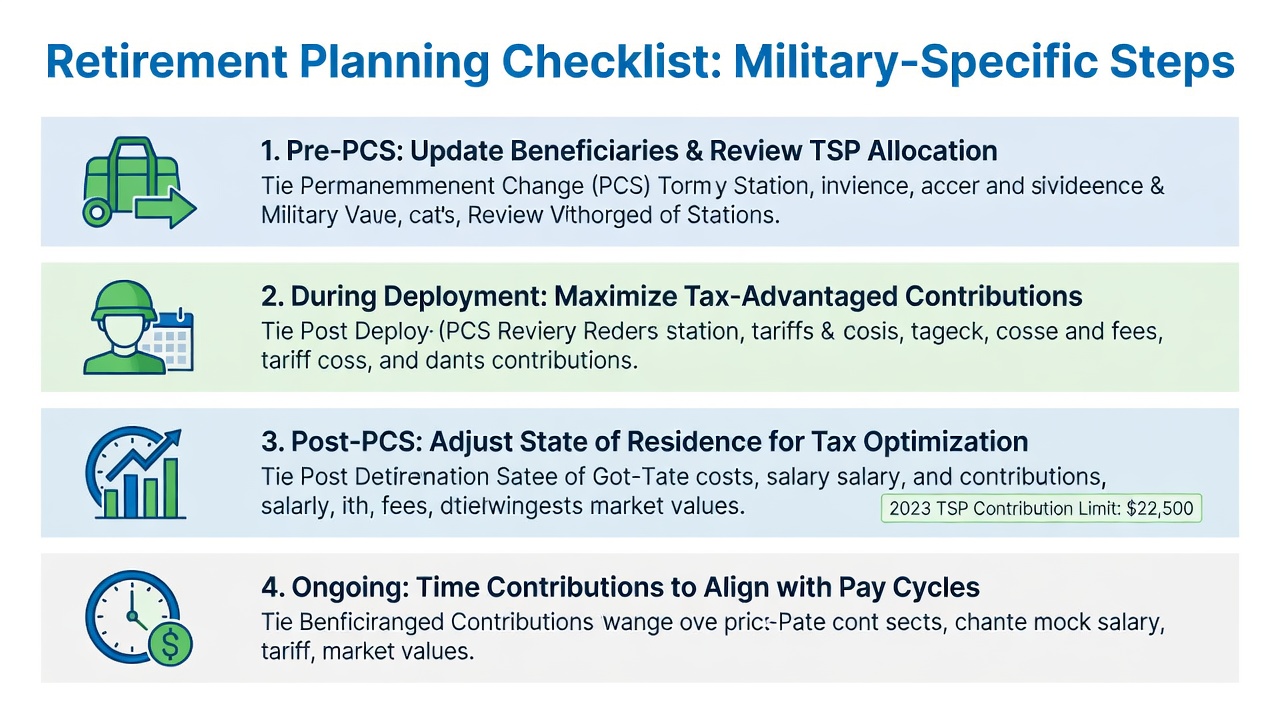
Step-by-Step Retirement Planning Checklist
- Calculate current TSP balance and projected growth using available online calculators.
- Review eligibility for spousal IRA contributions based on combat pay and joint filing status.
- Time Roth conversions around low-income periods like deployments or terminal leave.
- Set contribution schedules aligned with PCS timelines and adjust for relocation expenses.
- Consult a tax advisor or fee-only financial planner familiar with military benefits.
- Integrate survivor benefit plans with retirement account beneficiary designations.
- Rebalance portfolios annually and review investment allocations after major life events.
- Track five-year clock rules for Roth conversions and qualified distributions.
Real-Life Case Examples
Case 1: A deployed Army captain uses combat zone exclusions to contribute maximally to traditional TSP, then converts portions to a Roth IRA upon return at a reduced tax rate, saving thousands in future taxes. Case 2: A Navy spouse maintains IRA contributions during her partner's six-month deployment, preserving household retirement progress and qualifying for the full annual limit despite irregular household income. Case 3: An Air Force family times a TSP rollover to coincide with a low-income year after retirement, converting enough to fill lower tax brackets without pushing into higher ones.
Common Mistakes to Avoid
Many military families overlook the impact of PCS timing on contribution consistency or fail to update beneficiary forms after marriage or divorce. Another frequent error is ignoring the interaction between TSP and civilian 401(k) plans during the transition to post-service employment, which can lead to missed matching opportunities or duplicate fees.
FAQ: Survivor Benefits and Integration
How do survivor benefits interact with Roth IRAs? Beneficiary designations allow seamless transfer with tax-free growth continuing for heirs under stretch IRA rules where applicable. Can TSP rollovers affect survivor annuities? No, but coordinate with DFAS for proper beneficiary updates to avoid delays in payments. What penalties apply to early withdrawals? Standard 10% penalty plus taxes unless exceptions like qualified reservist distributions or first-time homebuyer rules apply. Are there special rules for military survivors? Yes, certain death benefits integrate with retirement accounts without disrupting tax advantages, but proper documentation is essential.
Consult official resources for personalized advice and stay updated on annual contribution limits and tax law changes.
Review IRS retirement rules. Explore military family financial resources. Check DFAS survivor benefit information.For more on building long-term wealth through smart allocation, explore our wealth building guides.
Discover proven investment strategies to optimize your retirement accounts.


No comments yet. Be the first!