 Bullish Portfolio
Introduction to Risk Budgeting with Alternatives
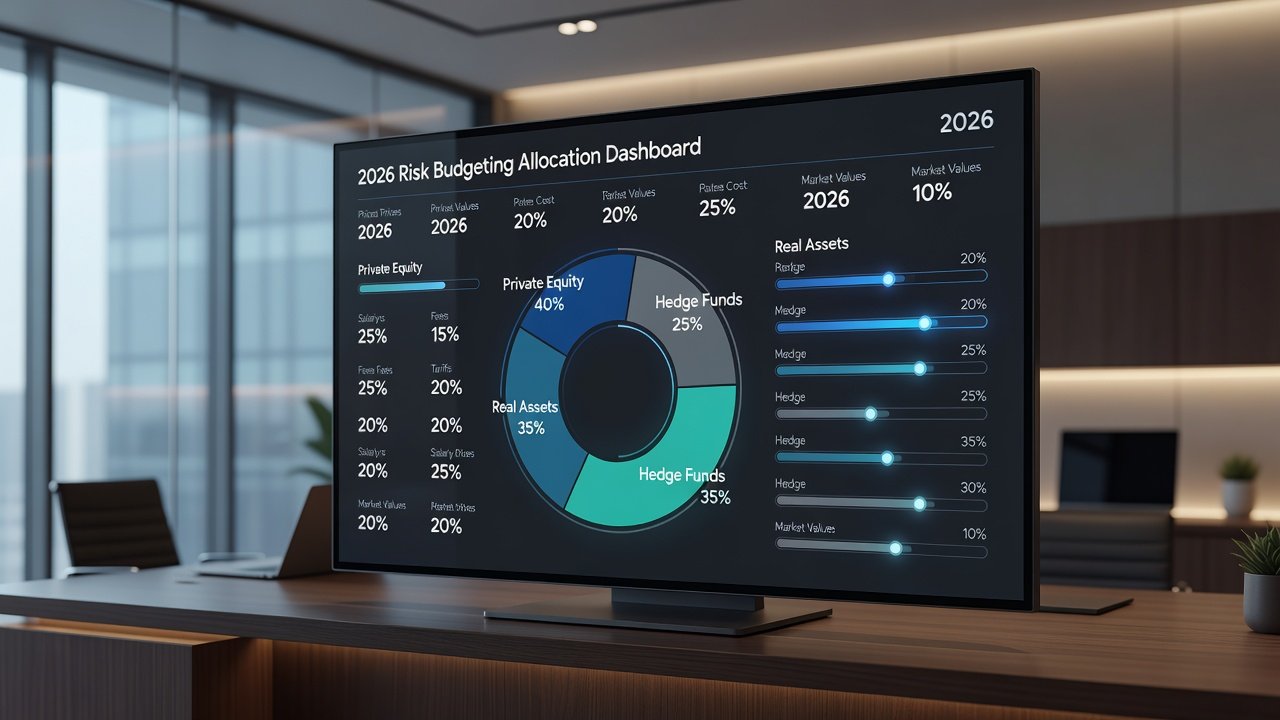
Risk budgeting provides a structured approach to allocating portfolio risk rather than capital alone. In 2026, investors face elevated volatility from geopolitical shifts and evolving monetary policies. Integrating alternatives such as private equity, hedge funds, and real assets enhances diversification beyond traditional stocks and bonds. This guide details the framework, selection process, and dynamic adjustments needed for robust 2026 portfolios. Investors who rely solely on capital weighting often find their equity exposure dominates downside risk, leading to larger drawdowns during market stress. By contrast, a risk-budgeted approach measures each sleeve's contribution to total volatility and caps those contributions explicitly. This method has gained traction among institutional allocators seeking to navigate uncertain economic conditions expected throughout 2026.
Traditional 60/40 portfolios often concentrate risk in equities. Risk budgeting counters this by assigning explicit risk limits to each asset class, ensuring no single sleeve dominates downside exposure. The result is a more resilient allocation that can weather regime changes without requiring constant tactical overrides.
Defining the Core Risk Budgeting Framework
Begin by establishing total portfolio risk tolerance, typically measured via volatility or value-at-risk metrics. Allocate risk budgets proportionally to expected contributions from each sleeve. For example, equities might receive 50% of the risk budget while alternatives absorb 30-40% to capture uncorrelated returns. Practitioners calculate marginal risk contributions using covariance matrices derived from recent return data, then adjust weights until each sleeve hits its assigned risk target.
Key steps include calculating marginal risk contributions and rebalancing when actual allocations deviate from targets. This framework adapts well to regime shifts, such as rising inflation or recessionary pressures expected in parts of 2026. Advanced users incorporate forward-looking signals from options markets and macroeconomic forecasts to refine budgets dynamically rather than relying solely on historical volatility.
Selecting Alternative Investment Sleeves
Private equity offers long-term growth potential with lower correlation to public markets. Investors should evaluate vintage-year diversification, sector focus, and manager track records through multiple cycles. Hedge funds provide tactical flexibility through strategies like long-short equity or macro overlays, allowing rapid response to short-term dislocations. Real assets, including infrastructure and commodities, deliver inflation protection and steady cash flows in many cases.
Evaluate sleeves based on liquidity profiles, fee structures, and historical drawdown behavior. Prioritize managers with transparent reporting and strong governance to align with fiduciary standards. Due diligence should include operational reviews, liquidity stress testing, and alignment of interests through co-investment opportunities.
Review SEC guidelines on alternative investments for compliance considerations when adding these sleeves. Additional context on global standards can be found via Federal Reserve resources on portfolio construction.
Dynamic Re-Allocation Across Volatility Regimes
Monitor market volatility indicators to shift risk budgets. In low-volatility regimes, increase exposure to higher-risk alternatives like private equity. During high-volatility periods, tilt toward defensive real assets and hedged strategies. Quantitative triggers, such as moving averages of realized volatility or changes in credit spreads, help automate portions of the process while leaving room for qualitative judgment.
Implement triggers such as a 20% spike in VIX levels to prompt rebalancing. This proactive method reduces sequence-of-returns risk and preserves capital. Case studies from 2022-2025 demonstrate that portfolios using regime-based risk budgeting experienced materially lower peak-to-trough declines compared with static allocations.
Step-by-Step Implementation Tactics
- Assess current portfolio risk using factor analysis tools and multi-asset risk models.
- Set explicit risk limits for each sleeve based on investor objectives and time horizon.
- Conduct due diligence on alternative vehicles, focusing on track records through recent market cycles and operational infrastructure.
- Establish a rebalancing calendar tied to volatility thresholds and liquidity windows.
- Document governance policies for ongoing oversight and periodic model validation.
- Run scenario analyses incorporating 2026-specific stressors such as policy rate paths and geopolitical events.
- Review tax implications and custody arrangements before finalizing vehicle selection.
Sample Allocations for Different Investor Profiles
Conservative investors might allocate 40% equities, 30% fixed income, 15% private equity, 10% hedge funds, and 5% real assets. Moderate profiles could shift to 35% equities, 25% fixed income, 20% private equity, 12% hedge funds, and 8% real assets. Aggressive investors often target 30% equities, 15% fixed income, 25% private equity, 15% hedge funds, and 15% real assets. These targets represent risk contributions rather than market-value weights and require periodic recalibration as correlations evolve.
| Profile | Equities | Fixed Income | Private Equity | Hedge Funds | Real Assets |
|---|---|---|---|---|---|
| Conservative | 40% | 30% | 15% | 10% | 5% |
| Moderate | 35% | 25% | 20% | 12% | 8% |
| Aggressive | 30% | 15% | 25% | 15% | 15% |
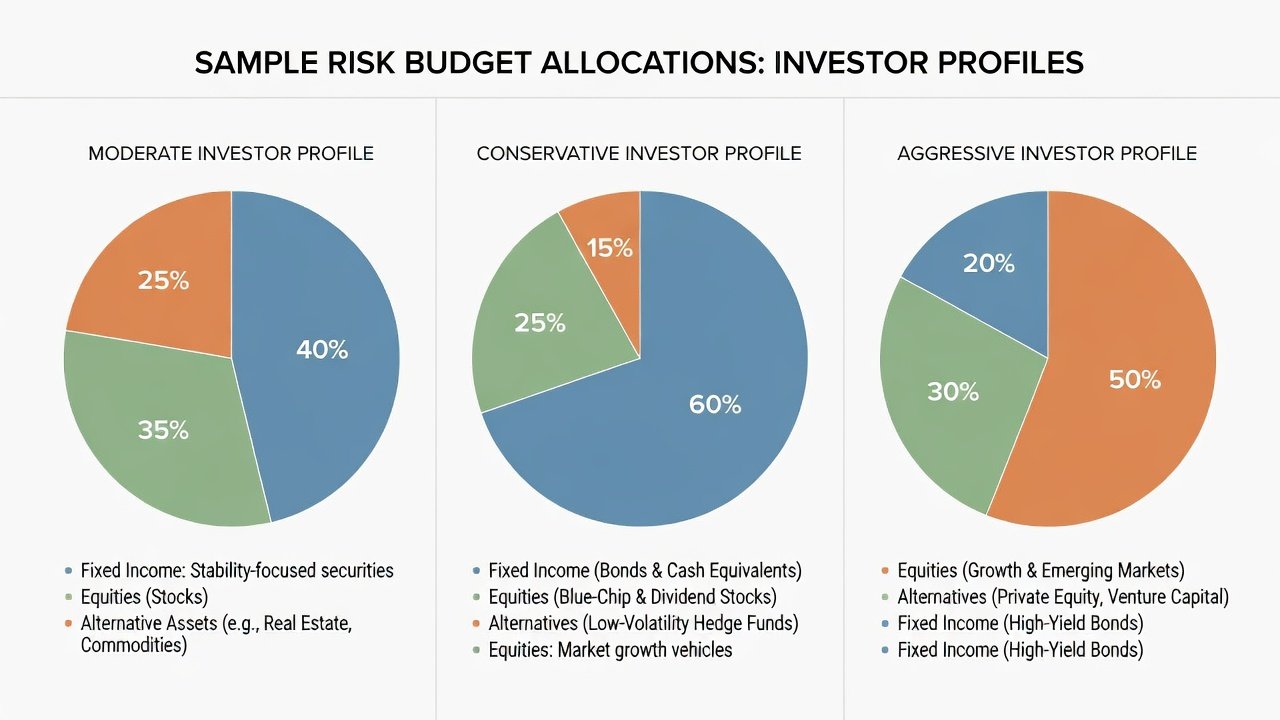
These percentages represent risk-budget targets rather than dollar allocations and should be stress-tested against 2026 forward-looking scenarios. Implementation often begins with a core-satellite structure where public markets form the core and alternatives act as satellites calibrated to specific risk budgets.
Comparison Tables Versus Traditional 60/40 Mixes
Compared with a standard 60/40 portfolio, risk-budgeted alternatives typically reduce maximum drawdowns by 15-25% while maintaining similar expected returns. Volatility metrics improve due to lower correlations, particularly when real assets buffer equity declines. Backtests covering 2008, 2020, and 2022 show that risk-budgeted mixes delivered higher Sharpe ratios and lower maximum drawdowns across most investor profiles.
Real-World 2026 Scenarios
Consider a moderate investor facing a simulated 2026 inflation spike: increasing real asset risk budget by 5% while trimming equity exposure helps stabilize returns. In a recession scenario, expanding hedge fund allocations cushions losses through short positions and trend-following overlays. A third scenario involving sudden rate cuts might prompt a modest increase in private equity risk budget to capture illiquidity premia during recovery phases.
Consult Federal Reserve economic projections to inform scenario planning. These exercises should be repeated quarterly and updated whenever macroeconomic assumptions shift materially.
Common Pitfalls to Avoid
- Overlooking liquidity mismatches during rebalancing windows, which can force suboptimal sales.
- Ignoring fee drag from complex alternative structures that erode net risk-adjusted returns.
- Failing to update risk models with current regime data, leading to stale budgets.
- Concentrating alternatives in a single vintage year or strategy, amplifying idiosyncratic risk.
- Neglecting operational due diligence on fund administrators and valuation processes.
Frequently Asked Questions
How do liquidity concerns affect risk budgeting with alternatives?
Private equity and certain real assets feature lock-up periods. Build liquidity buffers in public market sleeves to meet rebalancing needs without forced sales. Investors should model cash flow requirements under stressed conditions before committing capital.
What fee considerations arise when adding hedge funds and private equity?
Focus on net-of-fee risk-adjusted returns. Negotiate lower management fees on larger commitments and align performance incentives with long-term portfolio goals. Transparent fee reporting enables accurate comparison across managers.
Can risk budgeting replace traditional asset allocation entirely?
It complements rather than replaces allocation. Combine both approaches for comprehensive risk oversight in 2026 environments. Many sophisticated investors now run parallel capital and risk budgets to cross-check decisions.
How frequently should risk budgets be reviewed in 2026?
Quarterly reviews are standard, with ad-hoc updates triggered by significant market moves or changes in investor circumstances. Annual deep dives should incorporate updated forward-looking assumptions and peer benchmarking.
Conclusion
Applying risk budgeting with alternatives in 2026 requires disciplined framework design, careful sleeve selection, and ongoing regime monitoring. Investors who follow the step-by-step tactics outlined above can achieve more resilient portfolios that balance return potential with controlled downside risk. Regular stress testing and governance documentation further support long-term success in an uncertain investment landscape.
No comments yet. Be the first!