 Bullish Portfolio
Introduction to Industrial REITs for Passive Income
Industrial real estate investment trusts (REITs) represent one of the most reliable vehicles for generating passive income in today's market. These specialized trusts own, operate, and develop properties such as warehouses, distribution centers, manufacturing facilities, and increasingly data centers that power the digital economy. For investors seeking steady dividend streams without the responsibilities of direct property management, industrial REITs provide exposure to essential infrastructure supporting global commerce and technology. In 2026, structural tailwinds including sustained e-commerce adoption, supply chain resilience efforts, and explosive data demand create an environment where well-selected industrial REITs can deliver both income growth and capital appreciation. This comprehensive guide extends proven selection frameworks into an actionable, step-by-step process designed to help readers construct their first industrial REIT portfolio with confidence.
Unlike residential or retail REITs, industrial assets benefit from long lease durations, creditworthy corporate tenants, and lower turnover rates. Dividend yields typically range from competitive levels supported by contractual rent escalations, making them suitable for retirement accounts or taxable brokerage portfolios focused on income. Understanding how to evaluate these vehicles requires attention to specific operational metrics and sector dynamics that differentiate winners from laggards.
Key 2026 Metrics for Evaluating Industrial REITs
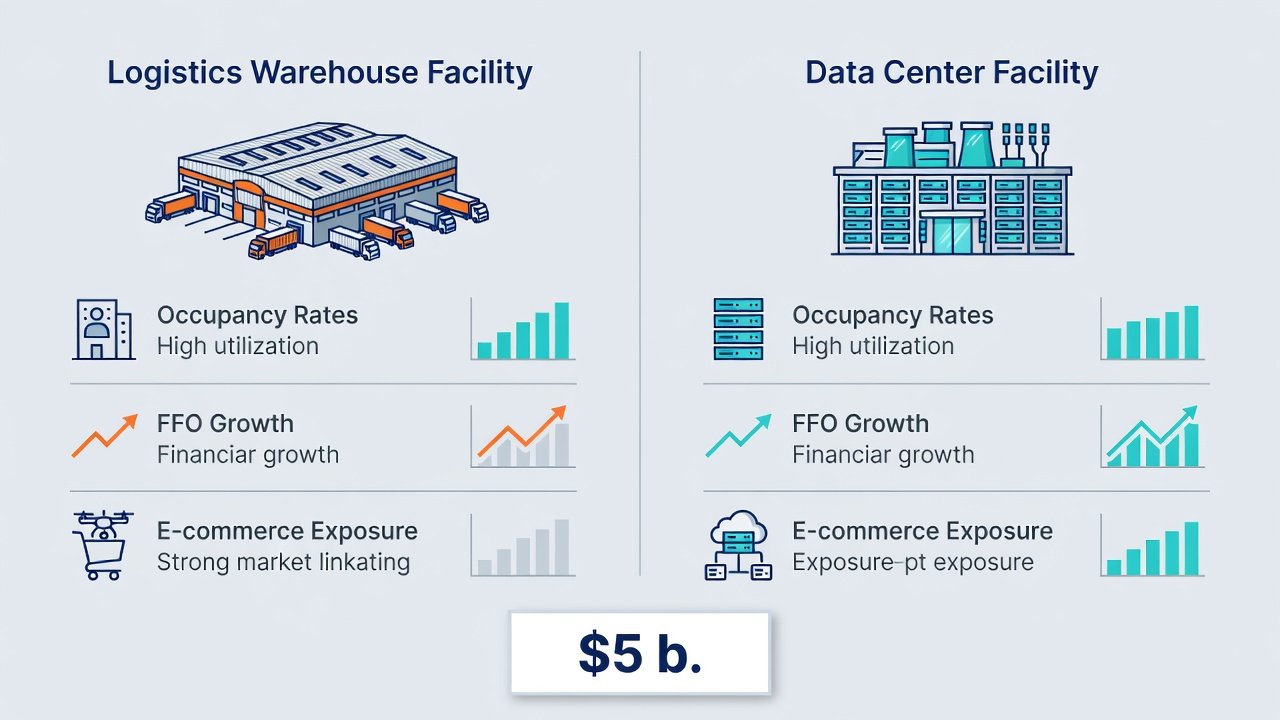
Selecting the right industrial REITs begins with rigorous analysis of quantitative metrics that signal operational health and future dividend sustainability. Occupancy rates serve as the foundational indicator, reflecting the percentage of rentable space currently leased to tenants. In a strong market, target REITs with portfolio-wide occupancy above 95 percent, as this minimizes vacancy risk and supports predictable cash flows. Lower occupancy often signals competitive pressure or misaligned property locations.
Funds from operations (FFO) growth provides a clearer picture of earnings power than traditional net income, since it adds back depreciation and other non-cash items common in real estate accounting. Investors should examine trailing twelve-month FFO alongside forward guidance, seeking consistent annual growth of at least 5 to 8 percent driven by same-store rent increases and accretive acquisitions. E-commerce exposure can be quantified by reviewing tenant rosters for major online retailers, third-party logistics providers, and fulfillment operators. REITs deriving 25 percent or more of revenue from e-commerce-related tenants tend to exhibit stronger rent growth because these tenants prioritize proximity to population centers and invest heavily in automation upgrades.
Additional metrics include net asset value (NAV) premiums or discounts, which indicate whether shares trade above or below underlying property values, and debt metrics such as interest coverage ratios that ensure the REIT can service obligations even if rates remain elevated. Cross-referencing these figures across quarterly filings and earnings transcripts reveals management quality and capital allocation discipline.
Comparing Logistics and Data Center Sub-Sectors
Within the industrial REIT universe, logistics and data center properties represent the two primary growth engines, each with distinct risk-return profiles. Logistics assets function as the backbone of physical goods movement, encompassing last-mile delivery hubs, regional distribution centers, and large-scale fulfillment warehouses. These properties typically feature long-term leases with built-in escalators, high barriers to new supply in infill locations, and resilience across economic cycles. Occupancy tends to remain elevated due to structural undersupply in key markets, and rental growth benefits from e-commerce penetration that shows no signs of slowing.
Data centers, by contrast, cater to the insatiable demand for computing power, cloud storage, and artificial intelligence training. These facilities command premium rents because of specialized power and cooling requirements, yet they introduce different considerations such as energy cost volatility and rapid technological obsolescence. While logistics REITs offer defensive income characteristics with lower volatility, data center-focused vehicles can deliver outsized FFO expansion when hyperscale tenants sign multi-year contracts. A balanced allocation often pairs both sub-sectors to capture complementary growth drivers while mitigating concentration risk. Investors evaluating specific REITs should review geographic footprints, power purchase agreements for data centers, and lease rollover schedules for logistics assets to determine the optimal mix for their income objectives.
Step-by-Step Industrial REIT Selection Process
Building a high-quality portfolio requires a disciplined, repeatable process. Begin by establishing screening criteria within your brokerage platform or research database, filtering for REITs with market capitalizations above $5 billion to ensure liquidity and analyst coverage. Next, download the latest 10-K and 10-Q filings to calculate or verify key ratios including occupancy, FFO per share growth, and leverage levels. Compare these against sector medians published by industry associations.
Once candidates pass quantitative screens, evaluate qualitative factors such as management experience, development pipeline quality, and tenant credit profiles. Review earnings call transcripts for commentary on rent spreads, acquisition activity, and macroeconomic outlook. Calculate implied dividend coverage using current FFO to ensure payouts remain sustainable at 70 to 85 percent of earnings. Finally, assess valuation by comparing current share prices to consensus NAV estimates and historical trading multiples. This multi-layered approach reduces the likelihood of selecting underperforming names and supports construction of a resilient income stream.
Portfolio Examples and Construction Tips
Consider three illustrative portfolio constructions for different investor profiles. A conservative income investor might allocate 60 percent to large-cap logistics REITs with proven dividend histories, 25 percent to diversified industrial names, and 15 percent to data center specialists for modest growth. A balanced approach could split 40 percent logistics, 35 percent data centers, and 25 percent to opportunistic industrial assets in emerging supply-chain corridors. Growth-oriented investors may tilt toward 50 percent data centers, 30 percent logistics, and 20 percent in development-stage names with higher upside. Rebalance annually or when sector weights drift more than 10 percent from targets. Dollar-cost averaging purchases over several quarters helps smooth entry prices amid market fluctuations.
Simple Scoring Checklist
- Portfolio occupancy consistently above 94 percent across trailing four quarters
- Positive FFO per share growth in each of the past three years with forward guidance supporting continuation
- Minimum 20 percent of rental revenue tied to e-commerce or technology tenants
- Debt-to-total-capitalization ratio below 50 percent with interest coverage above 3.5x
- Dividend payout ratio between 70 and 85 percent of FFO for sustainability
- Management team with at least ten years of sector experience and aligned compensation structures
- Geographic diversification across at least four major logistics or data markets
Common Pitfalls to Avoid
Many new investors fall into traps that erode long-term returns. Chasing the highest advertised yields without verifying FFO coverage often leads to dividend cuts when occupancy slips or interest expenses rise. Over-concentrating in a single sub-sector or geography amplifies risks from localized oversupply or regulatory changes. Ignoring development pipelines can result in future dilution from equity raises or value erosion from new competition. Failing to monitor interest rate sensitivity exposes portfolios to NAV compression during tightening cycles. Always maintain a watchlist of alternative REITs and review holdings quarterly to catch early warning signs such as declining same-store NOI or increasing lease expirations.
Supply-Chain Trends Driving Dividend Growth
Current supply-chain evolution continues to favor industrial property owners. Companies are investing in redundant manufacturing and warehousing capacity to mitigate disruption risks, increasing overall space absorption. Nearshoring from Asia to Mexico and the southern United States has accelerated leasing activity along key corridors, supporting above-average rent growth. Simultaneously, the proliferation of AI workloads drives hyperscale data center demand, translating into higher occupancy and power premium pricing for REITs with available capacity. These dynamics underpin expectations for continued dividend expansion among top operators. For deeper context on sector fundamentals, consult resources at reit.com and regulatory guidance at irs.gov.
FAQ: Tax Implications for US Investors
How are REIT dividends taxed in taxable accounts? Ordinary dividends are taxed at individual income tax rates, while portions classified as return of capital reduce the investor's cost basis and defer taxation until sale. Qualified dividends, when available, receive lower long-term capital gains rates.
Should REITs be held in IRAs or Roth accounts? Tax-advantaged accounts eliminate annual tax drag on distributions, allowing compounding on the full dividend amount. This structure particularly benefits high-yield industrial REITs.
What forms will I receive for tax reporting? Brokers issue Form 1099-DIV detailing ordinary dividends, capital gains distributions, and return of capital amounts. Foreign REIT holdings may also generate Form 1099-B and foreign tax credit information.
Are there state tax considerations? Most states conform to federal treatment, but a few impose additional taxes on REIT income or limit deductions. Review your state's revenue department guidance for specifics.
How do capital gains from REIT share sales differ? Gains on shares held longer than one year qualify for preferential long-term capital gains rates, separate from the character of ongoing distributions.
Conclusion
Applying this expanded selection framework equips investors to identify high-quality industrial REITs capable of delivering reliable 2026 passive income. By focusing on robust metrics, balanced sub-sector exposure, disciplined portfolio construction, and awareness of tax nuances, readers can build diversified holdings positioned to benefit from enduring supply-chain and digital infrastructure trends. Consistent monitoring and periodic rebalancing will help sustain performance over multiple market cycles.
No comments yet. Be the first!