 Bullish Portfolio

Why DRIPs in REITs Are a Game-Changer for Passive Income
Real Estate Investment Trusts (REITs) offer investors a steady stream of dividends from property income, making them a cornerstone of passive income strategies. But what if you could supercharge those dividends through automatic reinvestment? Dividend Reinvestment Plans (DRIPs) allow you to plow dividends back into more shares, harnessing the power of compounding without lifting a finger. In 2026, with REIT yields averaging around 4-5% and sectors like data centers booming, DRIPs can turn modest investments into wealth-building machines.
This guide dives deep into DRIPs for REITs, providing step-by-step setup instructions for top brokers, projected growth scenarios comparing reinvestment vs. cash strategies, and the best REIT sectors for optimal yields and risk-adjusted returns.
Understanding REIT DRIPs: The Compounding Engine
REITs must distribute at least 90% of taxable income as dividends, per IRS rules, ensuring high yields. DRIPs automate buying fractional shares with these dividends, avoiding brokerage fees in many cases and accelerating growth via compounding.
Benefits include:
- Cost Efficiency: No commissions on reinvested dividends.
- Exponential Growth: Reinvested dividends buy more shares, generating even larger future payouts.
- Dollar-Cost Averaging: Buys more shares when prices dip.
- Tax Deferral: Dividends are still taxable, but growth compounds pre-tax in taxable accounts.
For long-term portfolios, DRIPs shine in REITs due to their consistent payouts. According to data from the National Association of Real Estate Investment Trusts (NAREIT), REITs have delivered average annual total returns of 11.5% since 1972.
Step-by-Step Guide to Setting Up DRIPs in Popular Brokers (2026)
Most major brokers support DRIPs for REITs. Here's how to enable them on platforms dominating in 2026: Fidelity, Vanguard, and Charles Schwab.
Fidelity Investments
- Log into your Fidelity account at fidelity.com.
- Navigate to 'Accounts & Trade' > 'Account Features' > 'Dividend and Capital Gains'.
- Select the REIT holding (e.g., Realty Income or Prologis).
- Choose 'Reinvest in Security' for dividends.
- Confirm and save. Activation is instant for eligible shares.
Vanguard
- Access your Vanguard dashboard via investor.vanguard.com.
- Go to 'Holdings' for your portfolio.
- Click the REIT ticker > 'Dividend Reinvestment' options.
- Toggle 'Enroll in DRIP' and opt for full or partial reinvestment.
- Submit; changes apply to next dividend cycle.
Charles Schwab
- Sign in to schwab.com.
- Select 'Accounts' > 'Positions' > REIT position.
- Under 'Dividend Reinvestment', choose 'Reinvest Dividends'.
- Apply to all eligible securities or specific ones.
- Review and enable—no fees for Schwab One accounts.
Pro Tip: Verify REIT eligibility first; most publicly traded ones qualify. Synthetic DRIPs (broker-handled) are commission-free, while issuer DRIPs may offer discounts.
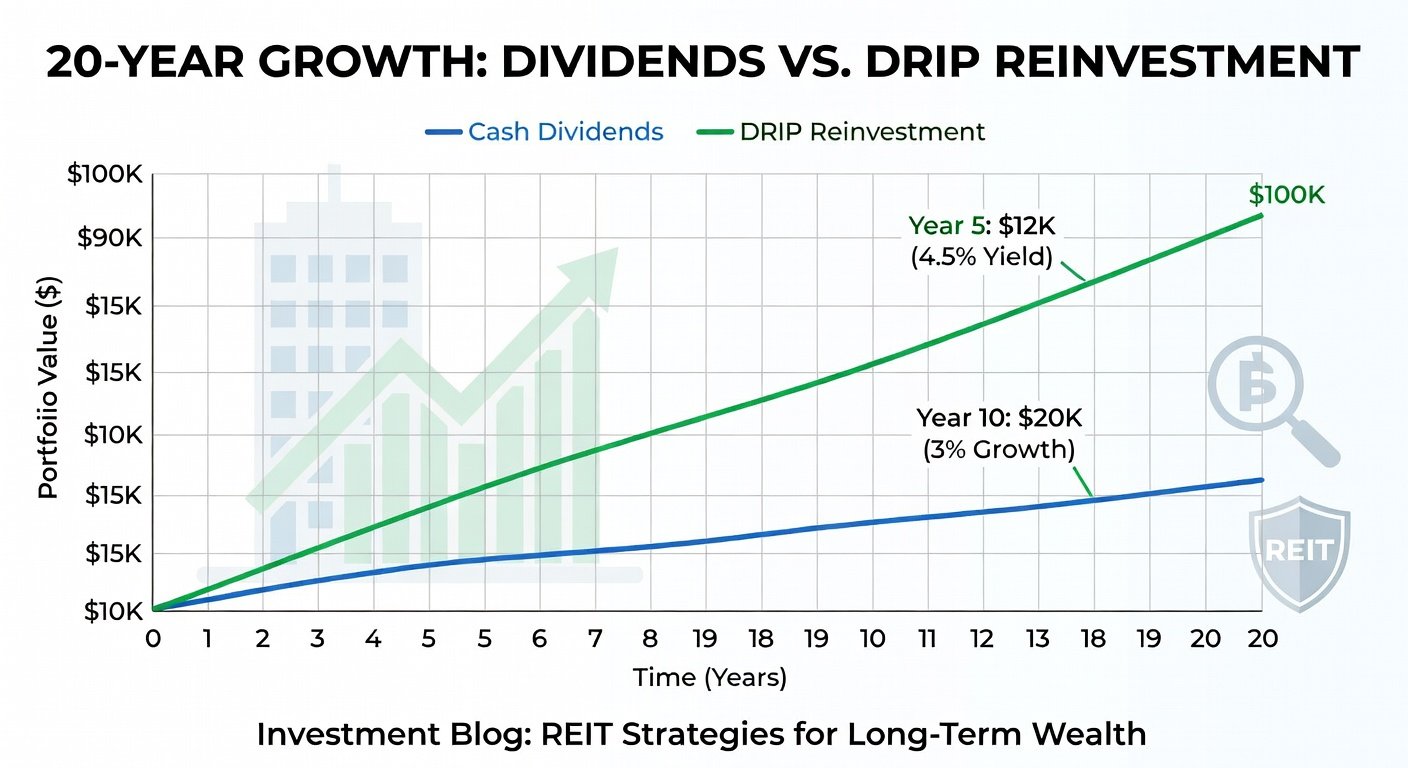
Reinvested vs. Cash Dividends: Projected Growth Scenarios
Let's crunch numbers using real-world data. Assume a $10,000 initial investment in a REIT yielding 4.5% annually, with 3% annual price appreciation (conservative per NAREIT historicals).
Scenario 1: Cash Dividends (No Reinvestment)
- Year 1: $450 dividend + $300 appreciation = $10,750 total.
- Year 10: ~$16,500 (compounding only on principal growth).
- Year 20: ~$27,000.
Scenario 2: Full DRIP Reinvestment
- Year 1: $450 reinvested buys more shares; total value $10,750.
- Year 10: ~$24,000 (48% higher than cash).
- Year 20: ~$55,000 (104% higher).
Over 30 years, DRIPs could double your ending balance. Using a 7% total return (yield + growth), Einstein's '8th wonder' shines: $10K becomes $76K cash vs. $222K reinvested.
These projections use historical REIT data; actual results vary with interest rates and economy. Tools like Dividend.com or Excel's FV function can model your specifics.
Top REIT Sectors for Yields and Risk-Adjusted Returns
Not all REITs are equal. Focus on sectors with strong fundamentals in 2026:
- Data Centers (e.g., Digital Realty, Equinix): Yields ~3-4%, but 15%+ CAGR from AI/cloud demand. Sharpe ratio >1.5 for low volatility.
- Industrial/Logistics (e.g., Prologis): 4% yields, e-commerce tailwinds. Resilient to recessions.
- Healthcare (e.g., Welltower): 5%+ yields, aging population driver. Defensive with inflation hedges.
- Residential (e.g., AvalonBay): 4% yields, housing shortages boost rents.
Avoid overexposed retail/office amid remote work shifts. Diversify via ETFs like VNQ (Vanguard REIT ETF) with DRIP options for broad exposure.
| Sector | Avg Yield | 5-Yr Return | Risk (Beta) |
|---|---|---|---|
| Data Centers | 3.5% | 12% | 0.8 |
| Industrial | 4.2% | 10% | 0.9 |
| Healthcare | 5.1% | 9% | 0.7 |
Portfolio allocation: 20-30% REITs via DRIPs for balanced passive income.
Risks and Best Practices
DRIPs amplify upside but also downside in REITs sensitive to rates. Mitigate with:
- Diversification across 10+ REITs/ETFs.
- Monitor FFO (Funds From Operations) metrics.
- Tax strategies: Hold in Roth IRAs for tax-free compounding.
- Exit if yields compress below 3% long-term.
Conclusion: Start Your DRIP Journey Today
DRIPs in REITs offer a hands-off path to compounded passive income. Set up via your broker, target high-growth sectors, and watch your portfolio multiply. In 2026's dynamic market, this strategy could be your ticket to financial independence.


No comments yet. Be the first!