 Bullish Portfolio
Introduction to Dividend Growth in Active Value Investing
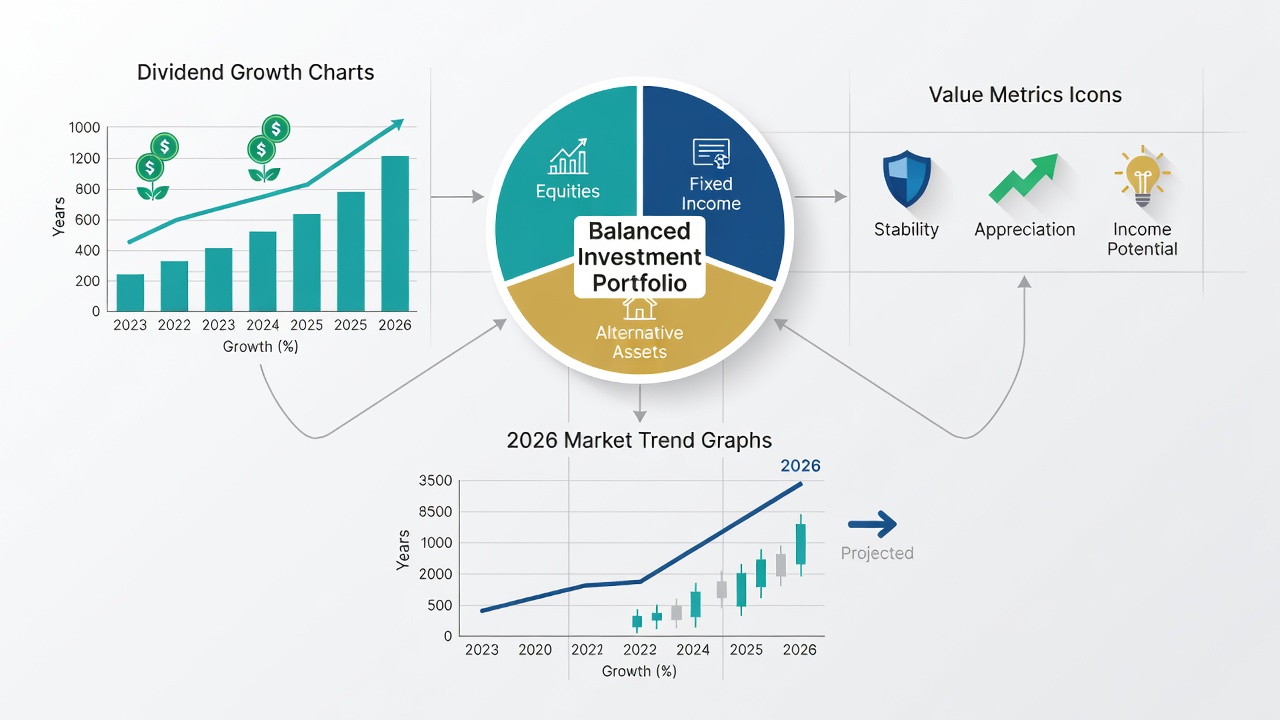
In 2026, investors navigate a landscape shaped by shifting interest rates, ongoing sector rotations, and gradual economic stabilization following prior volatility. Blending dividend growth principles with active value investing creates a robust framework for building portfolios that generate consistent income while capitalizing on undervalued opportunities. This integrated approach focuses on companies capable of sustaining and increasing dividend payouts over time, paired with classic value metrics such as discounted price-to-earnings ratios, attractive free cash flow yields, and solid balance sheet fundamentals. The result is a strategy that balances reliable income with potential for long-term capital appreciation, helping investors weather market uncertainties.
Active value investing relies on thorough fundamental analysis to uncover securities trading below their intrinsic worth, whereas dividend growth strategies target businesses with proven track records of raising distributions annually. Combining these methods adds a layer of discipline that pure value approaches sometimes lack, reducing the temptation to chase speculative rebounds. Investors benefit from compounding income streams that can offset inflation and support retirement goals or other financial objectives.
Stock Selection Criteria for Sustainable Payouts and Undervaluation
Selecting the right stocks demands a multi-layered evaluation process. Begin by examining dividend sustainability through payout ratios ideally kept below 60 percent to leave room for future increases, alongside dividend coverage ratios exceeding 2.0 times earnings. Complement these with value-oriented screens such as price-to-book ratios under 1.5 and enterprise value to EBITDA multiples that fall below sector medians. Earnings growth of at least 5 percent annually provides the foundation for ongoing dividend hikes, while positive operating cash flows and debt-to-equity ratios below 0.8 signal financial strength capable of enduring economic pressures.
Additional considerations include reviewing historical dividend growth streaks spanning at least five years and assessing management commentary on capital allocation priorities. Qualitative factors such as competitive moats and industry tailwinds further refine the list. This rigorous criteria set filters out high-yield traps and focuses attention on durable businesses positioned for both income growth and valuation recovery.
Sector-Specific Examples for 2026
Several sectors present compelling opportunities when applying these blended criteria. Healthcare stands out, with established pharmaceutical and medical device firms often undervalued due to regulatory scrutiny yet maintaining long histories of dividend growth supported by recurring revenue models. Financial services, especially well-capitalized regional banks, offer attractive entry points through conservative lending practices and rising net interest income that funds payout increases.
Consumer staples companies provide defensive stability, benefiting from inelastic demand and consistent cash generation that supports annual dividend raises. Industrial manufacturers tied to infrastructure projects frequently trade at discounts during transitional periods but demonstrate improving margins and asset-light operations that boost free cash flow. Utilities, when selected carefully for regulated rate structures and manageable debt loads, can also fit the profile by delivering predictable income with modest growth potential amid energy transition themes.
The 5-Step Allocation Framework
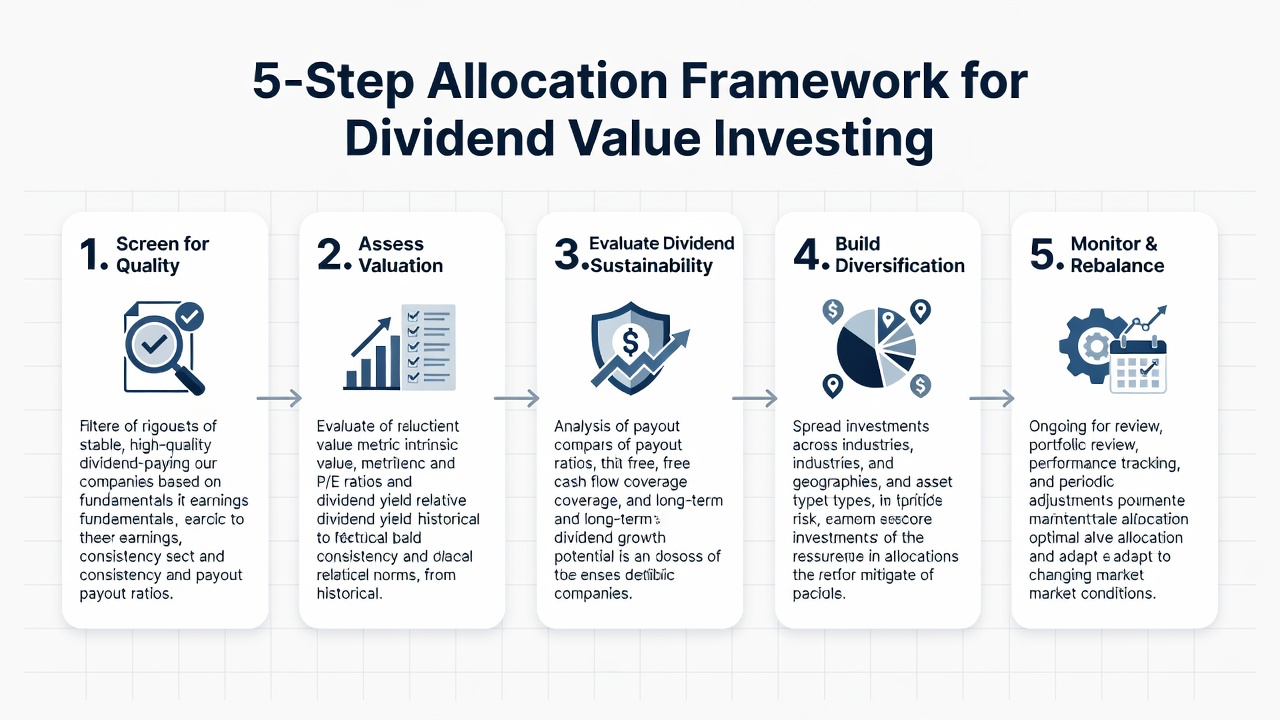
A disciplined allocation process translates selection criteria into a cohesive portfolio. The following five steps provide a repeatable roadmap:
- Establish clear income targets by assessing overall portfolio size, time horizon, and spending needs, typically targeting an initial yield in the 3 to 4 percent range with built-in growth expectations.
- Apply quantitative screens to generate a candidate pool of 20 to 30 names, then narrow to 10 to 15 holdings based on qualitative review and conviction levels.
- Enforce sector diversification limits, capping exposure to any single industry at 25 percent to avoid concentration risk.
- Determine position sizing through equal weighting or volatility-adjusted methods that account for beta and downside scenarios.
- Implement ongoing monitoring with quarterly reviews and predefined rebalancing rules triggered by dividend policy changes or valuation deviations beyond 20 percent.
This framework promotes consistency while allowing flexibility for market-specific adjustments.
Risk Assessment for Dividend Cuts
Dividend reductions represent a key vulnerability that requires proactive evaluation. Begin by analyzing historical payout behavior during previous recessions and stress periods, paying close attention to cash flow resilience and free cash flow conversion rates. Monitor macroeconomic signals such as inflation trends and interest rate trajectories that could pressure margins. Portfolio-level stress testing, including simulations of 20 to 30 percent revenue declines, helps quantify coverage adequacy under adverse conditions.
Geographic and business model diversification further mitigates risks, as does maintaining a small cash buffer for opportunistic additions during volatility. Regular review of earnings call transcripts and credit rating outlooks provides early warning signs before cuts materialize.
Comparisons with Pure Value or Active Methods
When contrasted with pure value investing, the dividend growth overlay introduces income stability that discourages panic selling during market corrections. This hybrid method often produces smoother return profiles with lower drawdowns. Relative to traditional active management without dividend constraints, the approach enforces payout discipline that typically results in lower portfolio turnover and improved tax efficiency through qualified dividend treatment.
Historical comparisons indicate that blended portfolios can deliver 1 to 2 percent higher annualized returns over multi-year periods while exhibiting reduced volatility, particularly in environments where income becomes a larger component of total return.
Real-World Case Studies
One illustrative example involves a mid-cap industrial company that traded at a 12 times earnings multiple with a 2.5 percent starting yield and an 8 percent annual dividend growth rate. Over a five-year horizon, dividend reinvestment combined with gradual valuation re-rating produced compounded returns that significantly outpaced the broader market. Another case centers on a healthcare services provider whose conservative capital structure and recurring revenue base allowed uninterrupted dividend growth despite regulatory headwinds, ultimately generating superior risk-adjusted performance.
A third scenario features a consumer staples multinational that maintained payout growth through supply chain disruptions by optimizing working capital, demonstrating how operational discipline supports both value recovery and income expansion.
Monitoring and Rebalancing Tactics
Effective oversight extends beyond initial construction. Establish alert systems for dividend announcements and earnings surprises. Rebalance using threshold-based triggers rather than fixed calendars to control transaction costs. Incorporate tax-loss harvesting opportunities during rebalancing windows while preserving overall dividend growth exposure. Periodic sector weight reviews ensure alignment with evolving economic conditions and prevent unintended drift.
FAQ: Tax Implications and Rebalancing Tactics
How do taxes affect dividend strategies? Qualified dividends generally receive favorable long-term capital gains tax treatment provided holding periods exceed 60 days. Investors should consult current guidance from the Internal Revenue Service for account-type considerations and reporting requirements.
What rebalancing tactics work best? Threshold-based rebalancing minimizes unnecessary trades compared with calendar schedules. Opportunistic tax-loss harvesting during market dips can enhance after-tax returns while maintaining strategy integrity.
How should investors handle macroeconomic shifts? Monitor indicators from sources such as the Federal Reserve to anticipate rate impacts on sector performance and adjust allocations accordingly.
Conclusion
Integrating dividend growth tactics within an active value investing framework equips portfolios to navigate 2026 market conditions effectively. Through disciplined selection, structured allocation, comprehensive risk assessment, and proactive monitoring, investors position themselves for sustainable income alongside capital appreciation. Consistent application of these principles supports long-term financial objectives amid changing economic environments.


No comments yet. Be the first!