 Bullish Portfolio
Why ETFs Are Your Best Bet for 2026
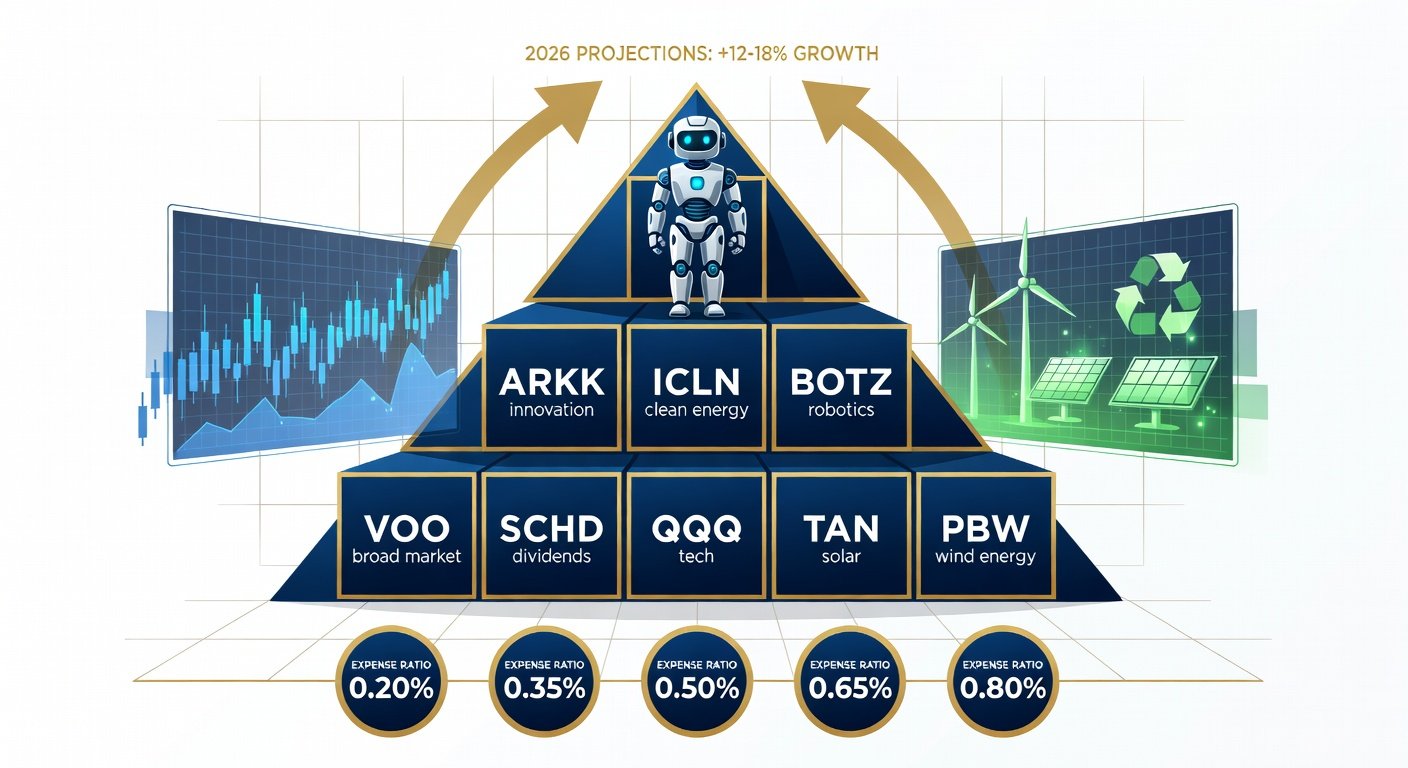
Exchange-Traded Funds (ETFs) offer diversification, low costs, and exposure to booming trends like AI growth and green energy transitions. With economic forecasts pointing to tech dominance and sustainable energy surges, 2026 could be a banner year for smart ETF investing. This guide ranks the top 10 ETFs across broad-market, sector, and thematic categories, factoring in expense ratios, key holdings, historical performance adjusted for future outlooks, and ideal investor profiles. We'll cap it with a beginner-friendly portfolio allocation.
Projections are based on analyst consensus from sources like Morningstar and Bloomberg, assuming 2-3% GDP growth, AI market expansion to $15 trillion by 2030, and green energy subsidies under global net-zero pledges.
1. VOO (Vanguard S&P 500 ETF) - Broad-Market Anchor
Expense Ratio: 0.03%
Key Holdings: Apple, Microsoft, Nvidia (top 10 make up ~30%).
Historical Returns: 10-year annualized ~13%. 2026 Outlook: Projected 12-15% return, buoyed by Big Tech resilience amid economic cycles.
Ideal For: Beginners seeking stable core exposure. Perfect for long-term buy-and-hold.
2. VTI (Vanguard Total Stock Market ETF) - Ultimate Diversification
Expense Ratio: 0.03%
Key Holdings: 3,700+ U.S. stocks, heavy in tech and healthcare.
Historical Returns: 10-year ~12%. 2026 Outlook: 11-14%, capturing small-cap rebound with AI spillover.
Ideal For: Passive investors wanting full U.S. market beta without stock-picking hassle.
3. QQQ (Invesco QQQ Trust) - Tech and AI Powerhouse
Expense Ratio: 0.20%
Key Holdings: Magnificent 7 (Nvidia, Amazon, Meta ~40%).
Historical Returns: 10-year ~18%. 2026 Outlook: 15-20%, driven by AI chip demand and cloud computing boom.
Ideal For: Growth chasers comfortable with volatility.
4. SMH (VanEck Semiconductor ETF) - AI Chip Leaders
Expense Ratio: 0.35%
Key Holdings: Nvidia, TSMC, Broadcom (semis ~70%).
Historical Returns: 10-year ~25%. 2026 Outlook: 18-25%, as AI data centers explode.
Ideal For: Aggressive investors betting on the AI infrastructure buildout.
5. BOTZ (Global X Robotics & Artificial Intelligence ETF) - Thematic AI Play
Expense Ratio: 0.68%
Key Holdings: Intuitive Surgical, ABB, UiPath.
Historical Returns: 5-year ~12%. 2026 Outlook: 16-22%, with robotics adoption in manufacturing and healthcare.
Ideal For: Thematic enthusiasts eyeing automation megatrend.
6. ICLN (iShares Global Clean Energy ETF) - Green Energy Surge
Expense Ratio: 0.41%
Key Holdings: First Solar, Enphase, Vestas Wind.
Historical Returns: 5-year ~10% (volatile). 2026 Outlook: 14-18%, fueled by policy support and falling solar costs.
Ideal For: ESG-focused investors balancing growth with impact.
7. TAN (Invesco Solar ETF) - Solar Powerhouse
Expense Ratio: 0.67%
Key Holdings: Enphase, SolarEdge, First Solar.
Historical Returns: 10-year ~15%. 2026 Outlook: 17-23%, as solar capacity doubles globally.
Ideal For: Sector bettors on renewable dominance.
8. SCHD (Schwab U.S. Dividend Equity ETF) - Income Stability
Expense Ratio: 0.06%
Key Holdings: Home Depot, Verizon, Cisco (high-yield dividend payers).
Historical Returns: 10-year ~11%. 2026 Outlook: 10-13%, with dividends yielding ~3.5% amid rate cuts.
Ideal For: Retirees or conservative portfolios needing yield.
9. VUG (Vanguard Growth ETF) - High-Growth Tilt
Expense Ratio: 0.04%
Key Holdings: Apple, Microsoft, Lilly (growth stocks).
Historical Returns: 10-year ~15%. 2026 Outlook: 14-18%, riding AI and biotech waves.
Ideal For: Younger investors with 10+ year horizons.
10. ARKK (ARK Innovation ETF) - Disruptive Innovation
Expense Ratio: 0.75%
Key Holdings: Tesla, Roku, CRISPR (high-conviction bets).
Historical Returns: 5-year ~5% (post-peak). 2026 Outlook: 12-20%, rebounding on genomics and autonomy.
Ideal For: Risk-tolerant speculators chasing moonshots.
Sample Portfolio Allocation for Beginners
Build a balanced $10,000 starter portfolio:
- 40% VOO ($4,000) - Core stability.
- 20% QQQ ($2,000) - AI growth.
- 15% ICLN ($1,500) - Green energy.
- 10% SCHD ($1,000) - Income buffer.
- 10% VTI ($1,000) - Broad diversification.
- 5% BOTZ ($500) - Thematic kicker.
Rebalance annually. Expected return: 12-16% with moderate risk. Use a brokerage like Vanguard or Fidelity for commission-free trades.
Risks and Final Tips
ETFs aren't foolproof—watch inflation, geopolitics, and recessions. Diversify beyond U.S. if possible. Always consult a financial advisor. Start small, invest consistently via dollar-cost averaging, and stay informed on trends like AI ethics and energy storage breakthroughs. 2026 awaits—position your portfolio now!
No comments yet. Be the first!