 Bullish Portfolio
Introduction to Tactical ETF Diversification in 2026
As economic conditions evolve into 2026, investors face heightened volatility driven by shifting interest rates, geopolitical tensions, and technological advancements. Tactical ETF diversification offers a dynamic approach beyond static buy-and-hold strategies, allowing adjustments to sector exposures based on emerging data. This method blends core index funds with targeted sector ETFs in areas like technology and healthcare to optimize returns while managing downside risks. Unlike passive strategies that maintain fixed allocations regardless of market conditions, tactical approaches enable investors to respond to real-time signals without abandoning long-term goals.
Traditional diversification spreads assets across broad markets, but tactical methods incorporate timely shifts. For instance, increasing healthcare exposure during periods of regulatory stability can provide defensive qualities, while tech allocations capitalize on innovation cycles. Data from economic indicators helps identify these windows, creating opportunities for enhanced risk-adjusted performance over multiple market cycles.
Understanding 2026 Economic Shifts and Volatility Drivers
Market participants anticipate continued fluctuations from factors such as inflation trends and supply chain disruptions. Tactical investors monitor these to adjust portfolios proactively. Core holdings in broad market ETFs provide stability, while satellite positions in sector-specific vehicles enable opportunistic moves. Volatility in 2026 may stem from evolving fiscal policies and global trade dynamics, requiring investors to stay informed through reliable macroeconomic sources.
Key volatility drivers include monetary policy decisions and sector-specific earnings reports. By layering tactical overlays, portfolios can adapt without full liquidation of core positions. Historical analysis reveals that periods of elevated uncertainty often reward those who rotate into defensive sectors early, while growth sectors surge during recovery phases. Understanding these patterns forms the foundation for effective tactical decisions.
Allocation Models: Blending Tech, Healthcare ETFs with Core Index Funds
A balanced model might allocate 60% to core index funds tracking major benchmarks, 25% to technology sector ETFs, and 15% to healthcare sector ETFs. This structure supports growth from tech innovation while hedging with healthcare's defensive characteristics during downturns. Alternative models include a growth-tilted version with 50% core, 30% tech, and 20% healthcare for aggressive investors, or a conservative variant emphasizing 70% core, 18% healthcare, and 12% tech.
Adjustments depend on cycle phases. In expansionary periods, tilt toward higher tech weights; in contractionary phases, boost healthcare. Comparisons of historical pre- and post-cycle performance show tactical models outperforming static ones by meaningful margins during volatile years, particularly when rebalancing occurs at clear inflection points identified through economic data.
Step-by-Step Reallocation Examples
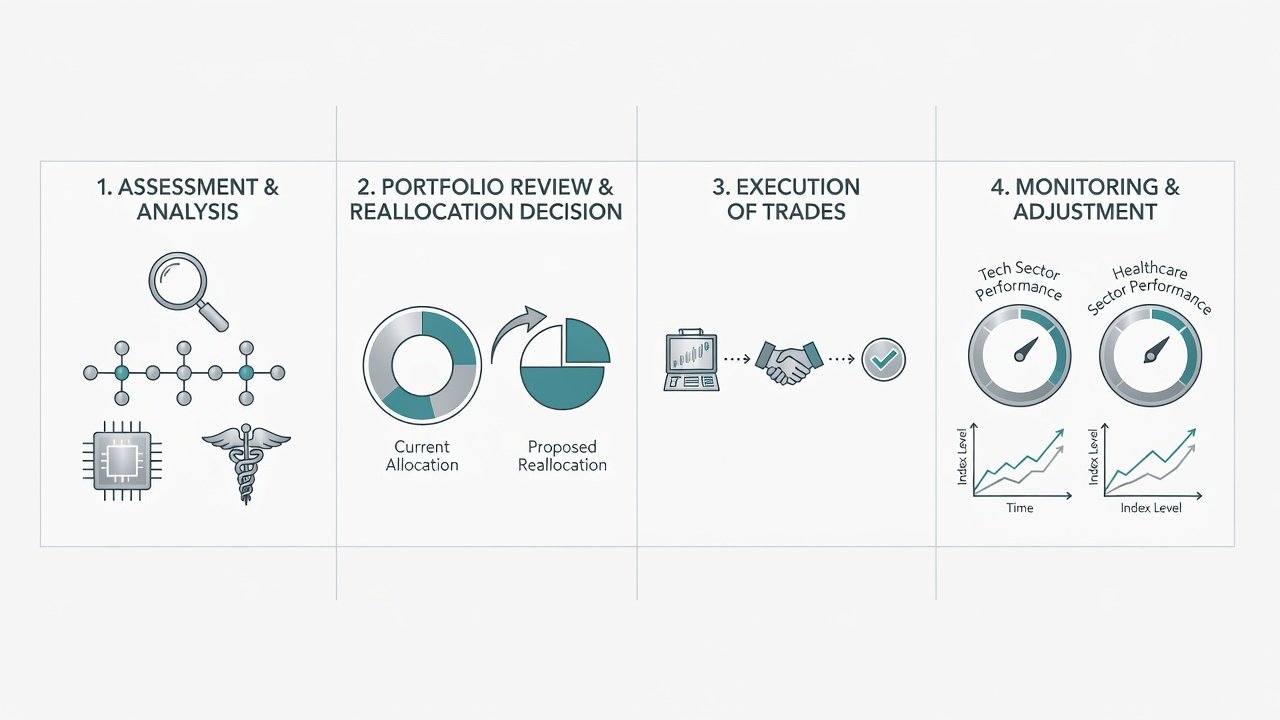
Follow these practical steps for reallocation, which provide a repeatable framework for implementation:
- Review quarterly economic data releases to spot triggers like rising unemployment claims or shifts in manufacturing indices.
- Calculate current portfolio weights using ETF holdings reports and compare them against target allocations.
- Identify target shifts, such as reducing tech by 5% and increasing healthcare by the same amount based on momentum indicators.
- Execute trades during low-volatility windows to minimize transaction costs and slippage.
- Reassess risk metrics post-reallocation, including standard deviation and Sharpe ratio, to ensure the portfolio remains aligned with objectives.
- Document the rationale for each change to support future reviews and learning.
An example scenario: Starting with a 50/30/20 split across core/tech/healthcare, a trigger like accelerated GDP growth prompts a move to 45/35/20, enhancing growth potential while maintaining overall diversification.
Data-Driven Triggers and Risk Metrics
Triggers include thresholds on indicators such as consumer price index changes or manufacturing output levels. Risk metrics like value-at-risk and beta relative to benchmarks guide decisions. Tactical approaches aim to keep portfolio beta below 1.1 during uncertain times to limit excessive drawdowns. Additional metrics worth tracking encompass maximum drawdown and correlation coefficients between sectors to avoid unintended concentration.
Pre-cycle performance often shows defensive sectors leading, while post-cycle recoveries favor growth-oriented tech. Investors should track these patterns using reliable sources like Federal Reserve economic data and Bureau of Labor Statistics reports. Incorporating multiple indicators reduces false signals and improves timing accuracy.
Benefits of Tactical Approaches Compared to Static Diversification
Tactical ETF strategies provide flexibility that static methods lack, allowing investors to capture upside in favorable sectors while protecting capital during stress. For example, rotating out of overvalued tech during late-cycle warnings can preserve gains that would otherwise erode. Risk management improves through active monitoring, and overall portfolio resilience strengthens when allocations reflect current economic realities rather than outdated assumptions.
However, tactical methods require discipline to avoid overtrading. Successful implementation combines quantitative triggers with qualitative judgment, leading to more consistent outcomes across varying market environments.
Common Mistakes to Avoid in Tactical ETF Diversification
Investors frequently err by chasing short-term trends without sufficient data backing or by neglecting core holdings during rotations. Another pitfall involves ignoring transaction costs and tax implications, which can erode returns over time. Failing to set clear rebalancing rules often results in emotional decision-making that undermines the strategy's effectiveness. To mitigate these issues, establish predefined thresholds and review processes before executing any changes.
Practical FAQs on Monitoring Tools and Portfolio Scenarios
What tools help monitor economic indicators?
Free platforms from government agencies provide real-time dashboards for GDP, employment, and inflation. Investors can also utilize SEC filings for deeper company-level insights within sectors. Paid services offer advanced alerts but starting with official sites ensures accuracy and timeliness without added expense.
Sample scenarios for different risk levels
- Conservative investors: 70% core, 15% healthcare, 15% tech with infrequent rebalancing every six months to prioritize capital preservation.
- Moderate: 55% core, 25% healthcare, 20% tech, quarterly reviews incorporating both economic data and sector momentum signals.
- Aggressive: 40% core, 30% healthcare, 30% tech, monthly tactical shifts based on momentum signals and volatility forecasts for those comfortable with higher turnover.
These scenarios demonstrate how risk tolerance influences allocation flexibility while maintaining diversification benefits across market regimes.
Conclusion
Tactical ETF diversification equips investors for 2026's economic landscape through disciplined sector rotations and core-satellite structures. By applying data-driven triggers and monitoring risk metrics, portfolios can navigate volatility effectively. Regular reviews ensure alignment with personal goals and market realities, positioning investors for both protection and growth opportunities ahead.
No comments yet. Be the first!