 Bullish Portfolio
Introduction to Cycle-Proof ETF Portfolios
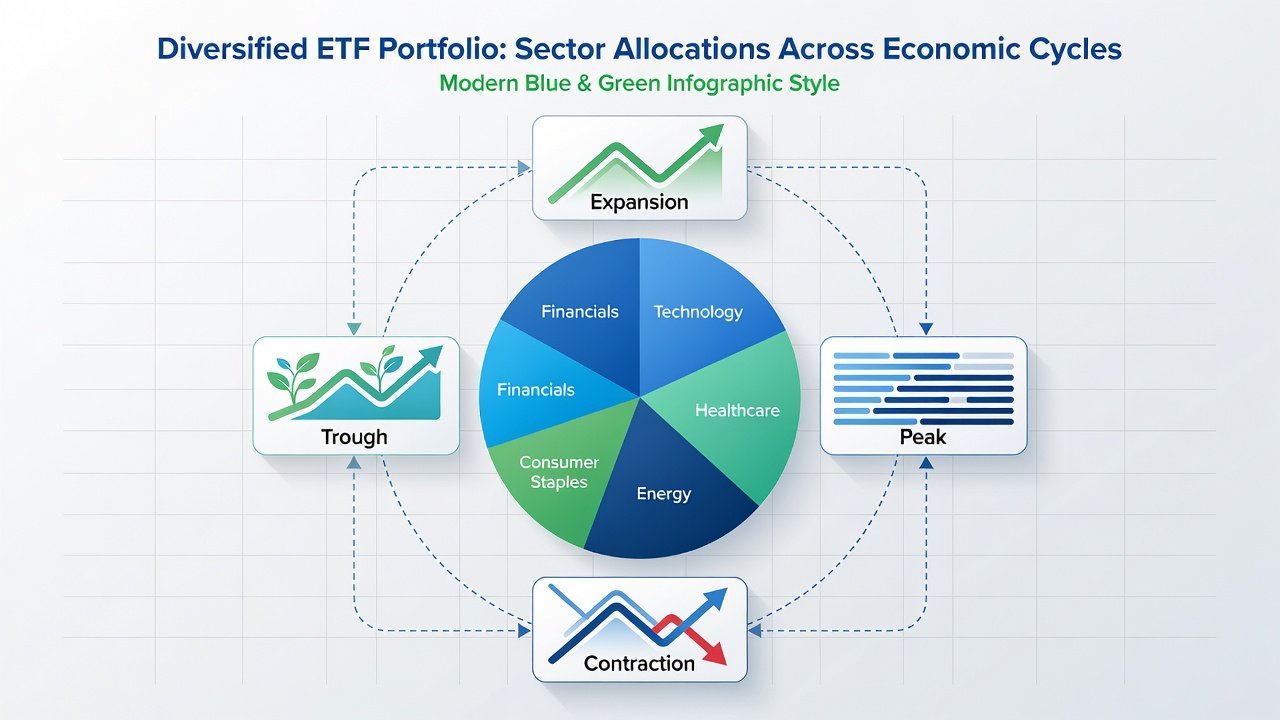
Economic cycles in 2026 will demand sophisticated diversification that combines sector ETFs with core index funds. Investors must prepare for expansion, peak, contraction, and recovery phases by understanding how different sectors respond to macroeconomic shifts. This approach minimizes drawdowns while capturing upside opportunities across the full cycle. Core index funds provide broad market exposure and low costs, while targeted sector ETFs allow tactical adjustments. Together they create resilient portfolios that adapt without constant trading. Many investors overlook the importance of aligning allocations with cycle phases, leading to unnecessary volatility and missed opportunities. By studying historical patterns and forward-looking indicators, portfolios can be structured to perform consistently regardless of the prevailing economic environment.
Understanding the Four Economic Phases in 2026
Expansion features rising GDP, strong corporate earnings, and moderate inflation. Peak periods show slowing growth and potential policy tightening. Contraction brings recession risks with declining output. Recovery follows with renewed demand and policy support. Monitoring indicators such as employment data and manufacturing surveys helps identify phase transitions early. The Federal Reserve publishes regular economic reports that support these assessments. Each phase presents unique challenges and opportunities for ETF investors. Expansion rewards growth-oriented holdings, while contraction favors stability-focused selections. Understanding these dynamics allows for proactive rather than reactive portfolio management.
Allocation Models for Each Phase
Expansion Phase
Allocate 60% to broad equity index ETFs tracking the S&P 500 or total market. Add 25% to cyclical sectors including technology and consumer discretionary. Maintain 15% in fixed-income index funds for stability. Within the equity portion, consider tilting toward mid-cap and small-cap indexes to capture higher growth potential during robust economic activity. This model balances aggressive participation in rising markets with a foundation of broad diversification.
Peak Phase
Reduce equity exposure to 50% and shift toward value-oriented index funds. Increase defensive sector ETFs in healthcare and consumer staples to 30%. Fixed income rises to 20%. At this stage, focus on quality factors within indexes to reduce sensitivity to potential corrections. Investors should also review dividend sustainability in selected holdings to prepare for possible earnings pressure.
Contraction Phase
Defensive positioning dominates with 40% in utilities and healthcare sector ETFs. Core index funds drop to 35% while bonds increase to 25%. This setup historically cushions volatility. Emphasize low-volatility index variants where available and consider adding a small allocation to treasury-focused bond ETFs for added safety during market stress.
Recovery Phase
Gradually rebuild equity allocations starting with 55% in broad indexes. Reintroduce growth sectors at 25% and reduce defensive holdings to 20%. Monitor early signs of stabilization such as improving consumer confidence before accelerating the shift back toward cyclical exposure.
Defensive Sector Selection Strategies
Utilities and healthcare provide reliable dividends and lower beta during downturns. Consumer staples deliver steady demand regardless of economic conditions. These sectors form the backbone of contraction defenses. Additional consideration should be given to real estate investment trust ETFs in certain recovery scenarios, though they require careful timing due to interest rate sensitivity. Defensive selection also involves evaluating sector-specific risks such as regulatory changes in healthcare or commodity price fluctuations in utilities. Diversifying within defensive categories prevents over-reliance on any single industry trend.
Dynamic Rebalancing Rules
Effective rebalancing prevents drift and maintains intended risk levels throughout the cycle. Key rules include reviewing allocations quarterly using economic phase signals. Rebalance when any sector deviates more than 5% from target weights. Incorporate volatility metrics such as VIX levels above 25 to trigger defensive shifts. Limit transaction costs by using tax-efficient ETF structures. Additional guidelines involve setting calendar-based reviews alongside event-driven triggers to avoid over-trading. Investors should document their rebalancing policy in advance to reduce behavioral biases during volatile periods.
- Review allocations quarterly using economic phase signals.
- Rebalance when any sector deviates more than 5% from target weights.
- Incorporate volatility metrics such as VIX levels above 25 to trigger defensive shifts.
- Limit transaction costs by using tax-efficient ETF structures.
- Document all changes for performance tracking and tax purposes.
Volatility Metrics to Monitor
Track standard deviation of returns, maximum drawdown, and correlation between sectors. Rising correlations signal increasing systemic risk and warrant defensive moves. Additional metrics include beta relative to major indexes and Sharpe ratio calculations to assess risk-adjusted performance. The SEC provides investor resources on understanding ETF risk disclosures that complement these metrics. Regular monitoring of these indicators enables timely adjustments before significant portfolio damage occurs.
Practical Portfolio Adjustment Examples
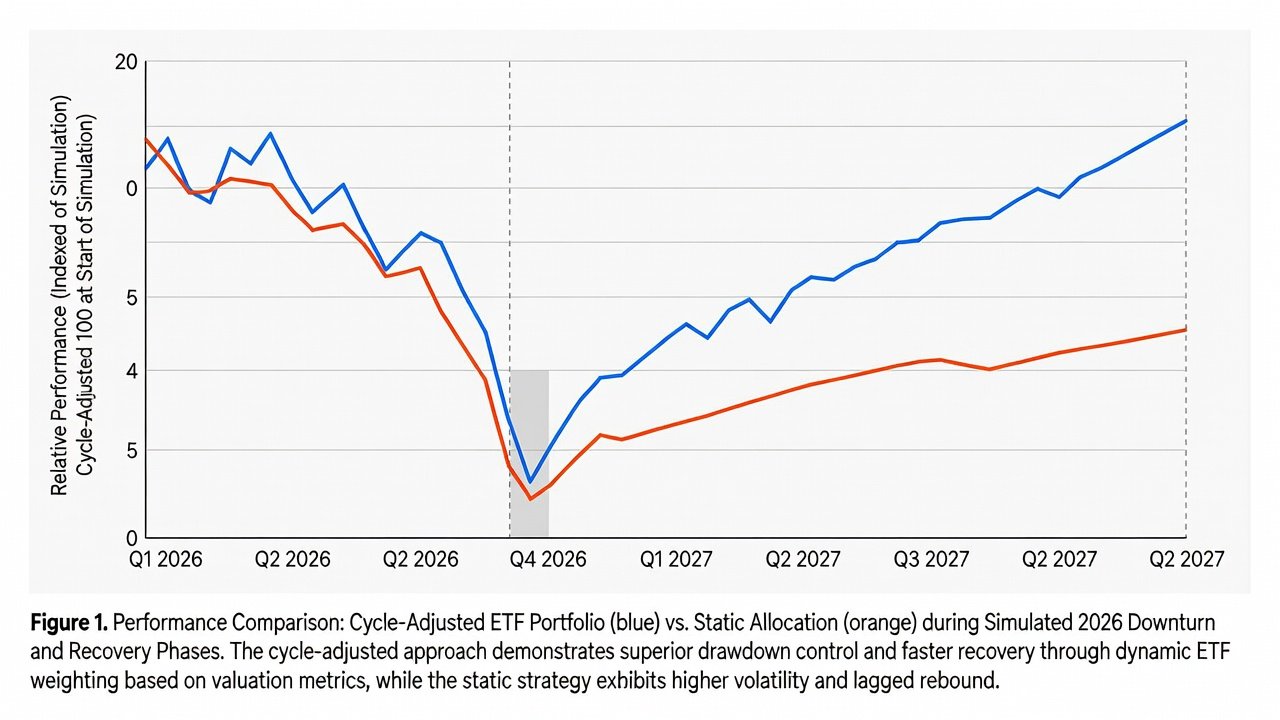
Consider a simulated 2026 downturn starting in Q2. An initial 60/25/15 equity-sector-bond mix shifts to 40/30/30 within one quarter. This adjustment reduces portfolio drawdown by approximately 12% compared to a static allocation in backtested scenarios. During recovery, re-entry into technology ETFs occurs in 5% increments as leading indicators improve. A second example involves a peak-to-contraction transition where value index funds are gradually swapped for defensive sector holdings over two months. This measured approach avoids market timing pitfalls while still providing meaningful protection. Investors can apply these examples by maintaining a simple spreadsheet that tracks target versus actual weights across phases.
Side-by-Side Performance Comparisons
Static 60/40 portfolios show higher volatility across cycles. Cycle-adjusted models using sector ETFs deliver smoother returns with comparable long-term growth. Historical data from multiple cycles confirms defensive sectors outperform during contractions while growth sectors lead expansions. When comparing risk metrics, the cycle-aware approach typically exhibits lower maximum drawdowns and improved recovery times. Side-by-side analysis also reveals that over-allocating to any single phase strategy can lead to underperformance in others, underscoring the need for flexibility. Investors benefit from reviewing these comparisons annually to refine their own models.
Conclusion
Building cycle-proof ETF portfolios requires disciplined phase recognition, targeted sector exposure, and strict rebalancing. Investors who implement these tactics position themselves for resilience in 2026 and beyond. Continuous education on economic indicators and ETF characteristics further enhances long-term success.
FAQ
How do I time cycle shifts accurately?
Use a combination of official economic releases and technical indicators rather than attempting precise forecasts. Focus on confirmation of phase changes before reallocating.
What are common cycle missteps?
Overreacting to short-term noise, ignoring correlations, and failing to rebalance regularly rank among the most frequent errors. Maintain a written investment policy to avoid these pitfalls.
Should beginners start with simple or advanced models?
Beginners benefit from starting with basic phase-aware allocations before adding more complex sector tilts. Gradual implementation reduces the risk of errors during initial adoption.
How often should volatility metrics be reviewed?
Weekly checks during uncertain periods and monthly reviews during stable times provide an effective balance between responsiveness and efficiency.

No comments yet. Be the first!