 Bullish Portfolio

Introduction to Large-Cap and Small-Cap Growth Stocks in 2026
Investors seeking bullish growth opportunities in 2026 face a key decision between large-cap and small-cap stocks. Large-cap companies offer established stability and consistent performance, while small-cap stocks provide higher growth potential amid market shifts. This comparison examines trends, valuations, sectors, and risk-reward profiles to help align choices with portfolio goals. Understanding these differences allows investors to build resilient portfolios that capture both steady appreciation and explosive upside. Market conditions in 2026 are expected to favor innovation-driven sectors, making cap-size selection more critical than ever for achieving superior returns.
Understanding Market Capitalization Categories
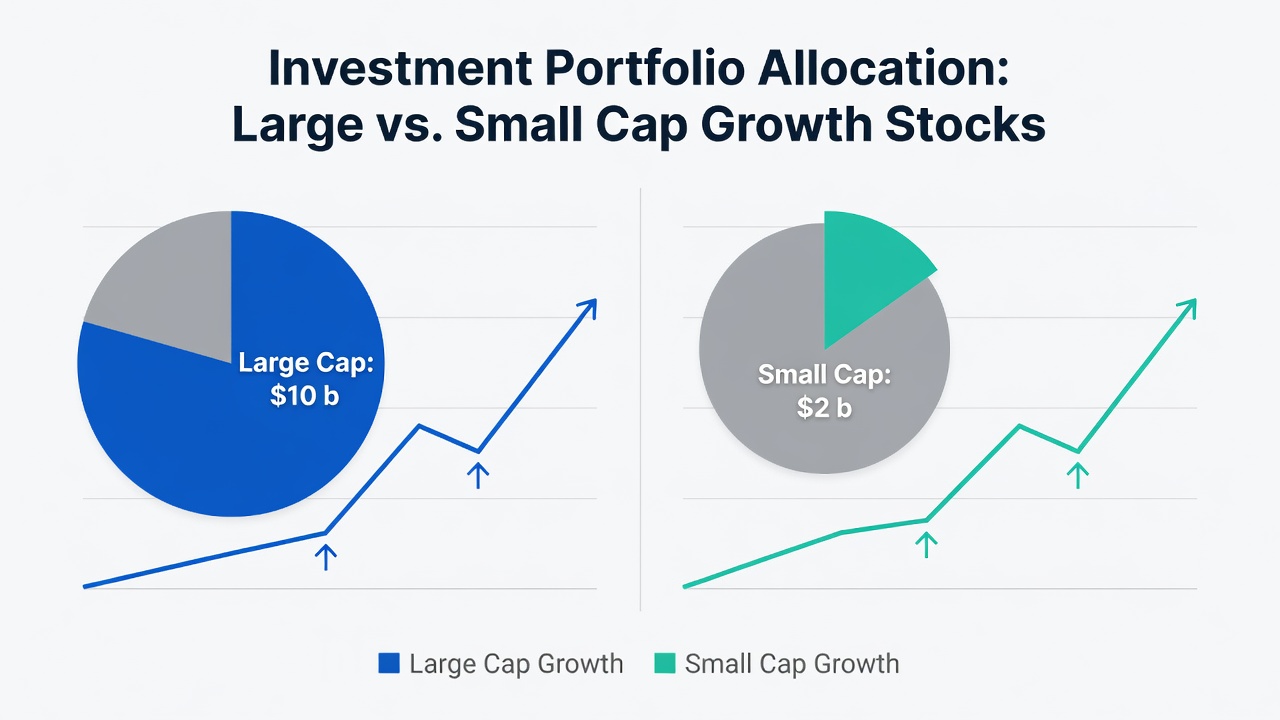
Large-cap stocks typically represent companies with market capitalizations exceeding $10 billion, known for resilience during volatility. These firms often have global operations, diversified revenue, and strong brand recognition that buffer them against economic downturns. Small-cap stocks, usually under $2 billion, often deliver outsized returns in expanding economies because they can pivot quickly and capture emerging trends. In 2026, forward-looking market conditions favor sectors like technology and healthcare for both categories, though dynamics differ significantly. Mid-cap stocks sometimes bridge the gap but are outside this focused comparison.
Performance Trends and Historical Context
Recent market cycles show large-caps outperforming in uncertain environments due to diversified revenue streams and access to capital markets. Small-caps tend to surge during recovery phases with greater earnings leverage and sensitivity to domestic growth. For 2026, analysts project continued bifurcation based on interest rate trajectories and economic expansion signals from sources like the Federal Reserve. Investors should review rolling five-year returns and sector rotation patterns to anticipate which category may lead in the coming year.
Valuation Differences and Metrics
Large-caps often trade at premium multiples reflecting lower risk and predictable cash flows, while small-caps appear undervalued on metrics like price-to-earnings and price-to-sales ratios, offering entry points for growth hunters. Key ratios to watch include enterprise value to EBITDA and free cash flow yield. Investors should monitor forward valuations closely as 2026 unfolds and compare them against historical averages for each size segment.
Sector Examples for Bullish Growth
Technology and renewable energy sectors highlight opportunities across both market caps. Large-cap leaders provide scale advantages in cloud computing and semiconductor manufacturing, while small-cap innovators capture niche expansions in artificial intelligence applications and battery technology. Healthcare also shows promise through biotechnology breakthroughs and medical device advancements that benefit companies of varying sizes. Investors can examine earnings growth forecasts within these sectors to identify candidates with strong momentum heading into 2026.
Risk-Reward Analysis
Large-caps balance moderate returns with lower downside, suiting conservative growth seekers who prioritize capital preservation. Small-caps carry higher volatility but reward patient investors with amplified upside in favorable 2026 conditions driven by M&A activity and product launches. Diversification across both categories mitigates concentration risks and smooths portfolio drawdowns during unexpected market events.
Allocation Strategies for 2026 Portfolios
A balanced approach allocates 60-70% to large-caps for stability and 30-40% to small-caps for growth. Tactical tilts can increase small-cap exposure when economic indicators strengthen. Rebalancing quarterly helps capture opportunities while managing exposure. Factor in personal risk tolerance, time horizons, and tax implications when implementing these strategies. Dollar-cost averaging into small-caps during dips can enhance long-term compounding effects.
Practical Evaluation Steps
- Review market capitalization and liquidity metrics using reliable financial platforms.
- Analyze revenue growth forecasts and competitive positioning through earnings transcripts.
- Assess valuation ratios against sector peers and historical norms.
- Evaluate balance sheet strength, debt levels, and cash reserves.
- Monitor macroeconomic indicators impacting 2026 performance such as GDP and inflation data.
- Examine management quality and insider ownership trends for alignment signals.
Specific Stock Illustrations
Consider a large-cap technology firm with established cloud services that continues to expand through acquisitions. Its predictable subscription revenue supports steady growth. In contrast, a small-cap healthcare innovator developing targeted therapies may experience rapid revenue acceleration once regulatory approvals are secured. These examples illustrate how size influences both the speed and magnitude of returns in bullish scenarios.
Market Condition Impacts
Economic growth, inflation trends, and regulatory changes will shape outcomes. Bullish 2026 scenarios amplify small-cap advantages through easier access to funding, while defensive rotations favor large-caps with global footprints. Rising interest rates typically pressure small-caps more due to higher borrowing costs, whereas falling rates provide tailwinds. Staying attuned to policy announcements helps investors adjust allocations proactively.
Common Mistakes to Avoid
Many investors chase small-cap performance without assessing liquidity risks or over-allocate to large-caps and miss growth opportunities. Ignoring sector overlap or failing to rebalance can lead to unintended concentration. Always verify forward-looking guidance rather than relying solely on past performance when selecting stocks for 2026.
Comparison Table: Large-Cap vs Small-Cap
| Aspect | Large-Cap | Small-Cap |
|---|---|---|
| Stability | High | Moderate |
| Growth Potential | Steady | High |
| Volatility | Lower | Higher |
| Valuation | Premium | Often discounted |
| Sector Focus | Broad | Niche |
| Liquidity | Excellent | Variable |
FAQ
What defines a bullish growth stock?
Bullish growth stocks exhibit strong earnings expansion potential supported by favorable market conditions and sector tailwinds.
How do large-caps differ from small-caps in risk?
Large-caps generally experience less price fluctuation due to established operations, while small-caps face greater uncertainty but offer higher reward potential.
Should investors mix both in one portfolio?
Yes, combining both enhances diversification and captures complementary benefits across market cycles.
What role does liquidity play in small-cap selection?
Liquidity affects ease of entry and exit; lower liquidity in small-caps can lead to wider spreads and higher transaction costs during volatile periods.
How often should allocations be reviewed?
Quarterly reviews aligned with earnings seasons help maintain target weights and respond to shifting market conditions.
Conclusion
Choosing between large-cap and small-cap bullish growth stocks for 2026 requires weighing stability against upside. Thoughtful allocation, rigorous evaluation, and ongoing monitoring position investors for success amid evolving conditions. Consult the SEC and Investor.gov for regulatory insights and stay informed on market developments.


No comments yet. Be the first!