 Bullish Portfolio

What Are Compounding Returns?
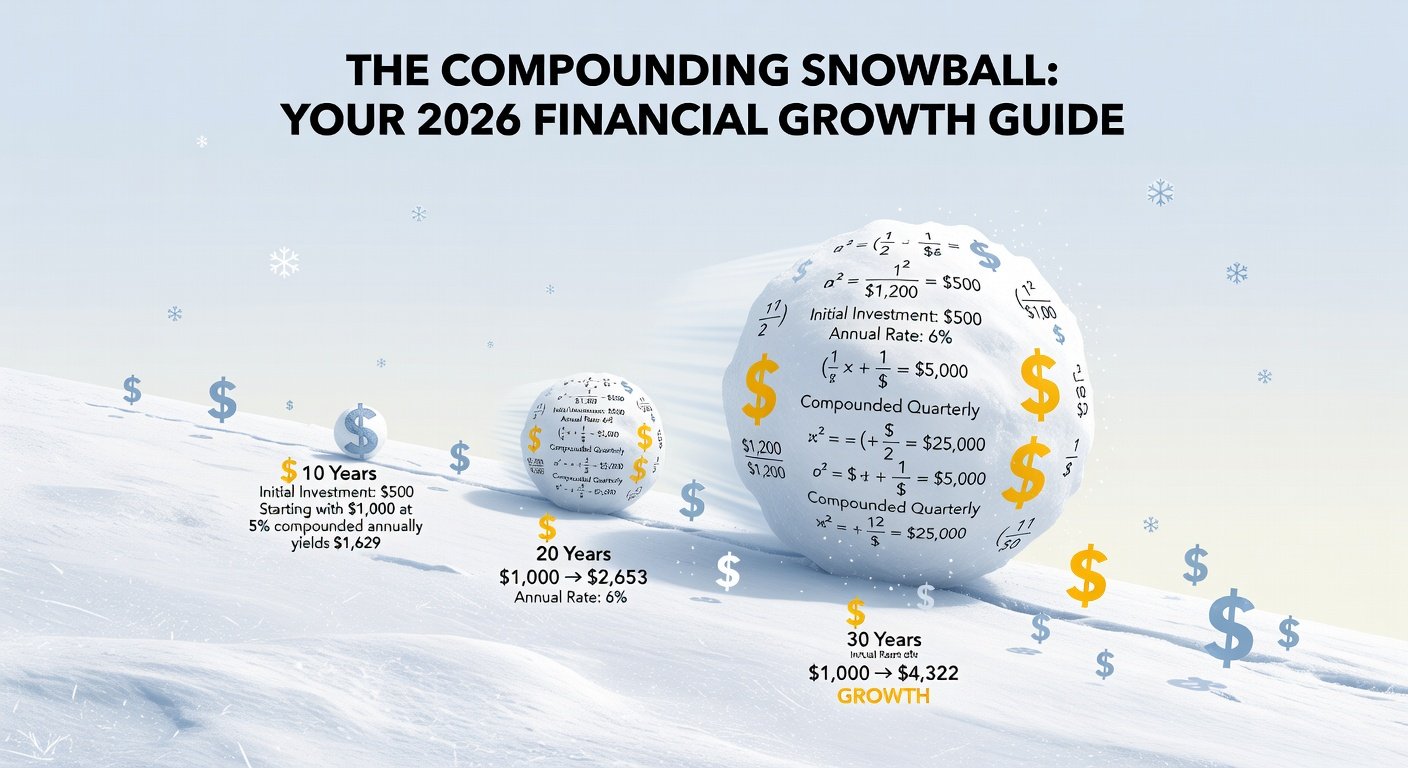
Compounding returns are the magic engine behind wealth building. It's not just earning interest on your money—it's earning interest on your interest, creating exponential growth over time. Albert Einstein reportedly called it the "eighth wonder of the world." For beginners aiming for financial independence (FI) in 2026's volatile markets, understanding compounding is essential.
In simple terms, if you invest $10,000 at 7% annual return, year one gives you $700 profit. Year two? You earn 7% on $10,700, and so on. This snowball effect turns modest savings into life-changing sums. With inflation cooling to around 2-3% projected for 2026 and stock markets stabilizing post-2025 volatility, now's the time to start.
Real-World Math Examples for 2026
Let's crunch numbers tailored to 2026 conditions. Assume a balanced portfolio: 60% stocks (S&P 500 expected 8-10% avg. return), 30% bonds (4-5% yields), 10% high-yield savings (projected 4.5% amid Fed rate cuts).
- Scenario 1: Monthly $500 invested at 7% net return (after 2% inflation). After 10 years: ~$85,000. After 20 years: ~$275,000. After 30 years: ~$760,000.
- Scenario 2: Lump sum $50,000 at 8% return. In 10 years: ~$108,000. 20 years: ~$233,000. 30 years: ~$503,000.
- High-Yield Twist: $200/month in a 5% HYSA grows to $32,000 in 10 years vs. $25,000 in a 1% bank.
These use the formula: Future Value = P(1 + r/n)(nt) + PMT[((1 + r/n)(nt) - 1)/(r/n)], where P=principal, r=rate, n=compounds/year, t=years, PMT=payment. For precise calcs, check Investopedia's compounding guide.
Essential Steps to Harness Compounding
- Select High-Yield Accounts: Ditch 0.01% savings. Opt for HYSA (4-5% APY in 2026), CDs, or money market funds. Vanguard's offerings shine here—visit Vanguard Investor for options yielding 4%+ safely.
- Automate Investments: Set recurring transfers to index funds/ETFs like VTI or VXUS. Apps like Acorns or Fidelity automate dollar-cost averaging, buying more shares when prices dip.
- Diversify for Steady Returns: 7-10% avg. from a 60/40 stock/bond mix beats cash. Robo-advisors like Betterment handle rebalancing.
- Max Tax-Advantaged Accounts: 401(k)s, IRAs compound tax-free. Contribute enough for employer matches—free money!
Avoid These Common Pitfalls
- Impatience: Compounding shines long-term. Don't panic-sell during 2026 dips.
- High Fees: 1% fees eat 25% of returns over 30 years. Stick to low-cost ETFs (<0.1% expense ratio).
- Inflation Blindness: 3% inflation halves purchasing power in 24 years. Aim for 5%+ real returns.
- Lifestyle Creep: Raise savings rate to 20-50% of income for FI faster.
Pro Tip: Track net worth monthly. Tools like Personal Capital help.
Customizable Compounding Calculator Template
Plug in your numbers with this HTML/JS template. Copy-paste into a file, open in browser, and project your FI path.
<html>
<head><title>Compounding Calculator</title></head>
<body>
  <h3>Your Path to FI</h3>
  Initial: $<input type="number" id="principal" value="10000">
  Monthly: $<input type="number" id="monthly" value="500">
  Rate (%): <input type="number" step="0.1" id="rate" value="7">
  Years: <input type="number" id="years" value="30">
  <button onclick="calculate()">Calculate</button>
  <p id="result"></p>
  <script>
    function calculate() {
      let p = parseFloat(document.getElementById('principal').value);
      let m = parseFloat(document.getElementById('monthly').value);
      let r = parseFloat(document.getElementById('rate').value) / 100 / 12;
      let t = parseFloat(document.getElementById('years').value) * 12;
      let fv = p * Math.pow(1 + r, t);
      let pmtFv = m * ((Math.pow(1 + r, t) - 1) / r);
      let total = fv + pmtFv;
      document.getElementById('result').innerHTML = 'Future Value: $' + Math.round(total).toLocaleString();
    }
  </script>
</body>
</html>
Tweak values for 2026 projections: 7% stocks, 4.5% savings. Run scenarios to hit $1M+.
Kickstart Your Journey Today
Start small: Open a HYSA, automate $100/month. In 2026's recovering economy, compounding will propel you to FI. Patience + consistency = wealth. What's your first step?


No comments yet. Be the first!